6  Mapping Collective Efficacy

Show code
# Load Packages
library(tidyverse)
library(easystats)
library(gt)
library(sf)
library(haven)
library(readxl)
library(here)
library(janitor)
library(viridis)
library(plotly)
library(mapview)
library(leaflet)
library(htmlwidgets)
library(biscale)
library(base64enc)
library(htmltools)

options(scipen = 999)

6.0.1 Introduction

In the previous chapter, we analyzed bivariate relationships between item- and scale-level measures of collective efficacy and perceived and experienced criminal behaviors in residents’ neighborhoods. We found that individuals who perceive their neighborhood to be high in collective efficacy (at least for certain items meant to measure the key sub-dimensions of collective efficacy–social cohesion and informal social control) generally perceived less crime in their neighborhood and, to a lesser extent, report fewer direct experiences with criminal victimization. Of course, the theory of collective efficacy was not developed to explain individual-level differences in neighborhood perceptions and crime. Rather, it was conceived as a collective neighborhood-level corollary to the classic psychological concept of self-efficacy. Instead of emphasizing an individual’s belief in their ability to succeed in specific situations or accomplish a specific task, collective efficacy is meant to capture a community or neighborhood’s collective “mutual trust or willingness to intervene for the common good…(Sampson et al., 1997: p. 919)” such as controlling crime and antisocial behavior. With this in mind, we turn to visualizing neighborhood-level variations in collective efficacy and crime below.

6.0.2 Load the Data

First, we need to load the crime rate data with geographic information for mapping and the survey data with a neighborhood identifier that corresponds to the neighborhoods in the crime rate data (see Appendix II section 11.0.1). We will also load the pre-processed analytic data from the prior chapter that includes our collective efficacy and crime-related items, sub-scales, and scales.

Show code
#Geographic data:
kcmo_crimerate_sf <- readRDS(here("Data", "kcmo_crimerate_sf.rds"))
kc_combsurv_geoid <- readRDS(here("Data", "kc_combsurv_geoid.rds"))
#Survey data:
kc_combsurv_ceanal <- readRDS(here("Data", "kc_combsurv_ceanal.rds"))
kc_combsurv_recode <- readRDS(here("Data", "kc_combsurv_recode.rds"))

6.0.3 Map Geography & Crime Rate Data

We can start by mapping the geographic characteristics of the data, including the neighborhoods that were sampled. The sf package is designed to work with a host of different plotting packages. While the sf package has some built-in plotting features and we typically prefer the generality of ggplot2 for making plots in R, the “leaflet” package seems to provide access to one of the most all-purpose mapping tools. So we’ll use that below to allow for some degree of interactivity.

First, we can map whether the neighborhood was sampled and whether it was part of the random or high crime sample.

Show code
sample_pal <- colorFactor(palette = c("white", "#FDE725FF", "#440154FF"),
                   domain = kcmo_crimerate_sf$sample_fact)

sample_map <- leaflet(kcmo_crimerate_sf) %>%
  addProviderTiles(providers$CartoDB.Positron) %>%  # Add Positron map tiles
  setView(lng = -94.5786, lat = 39.0997, zoom = 10) %>%  # KC coordinates  
  addPolygons(
    fillColor = ~sample_pal(sample_fact),
    weight = 1,
    opacity = 1,
    color = "black",
    dashArray = "",
    fillOpacity = 0.5,
    highlight = highlightOptions(
      weight = 3,
      color = "#666",
      dashArray = "",
      fillOpacity = 0.5,
      bringToFront = TRUE),
    popup = ~paste("Neighborhood:", NBHNAME,
                   "<br>Population (2020):", SUM_POP20,
                   "<br>Sample:", sample_fact,
                   "<br>Violent Crime (per 1,000):", VC_1000_Rate,
                   "<br>Property Crime (per 1,000):", PC_1000_Rate,
                   "<br>Total Crime (per 1,000):", Crime_1000_Rate),
    label = ~NBHNAME
  ) %>%
  addLegend(pal = sample_pal, 
            values = ~sample_fact, 
            opacity = 0.7, 
            title = "Sample",
            position = "bottomright")
sample_map
Show code
saveWidget(sample_map, file = here("maps", "sample_map.html"))

In the above plot, hovering over the neighborhoods will reveal their names and clicking on the neighborhoods will reveal additional information, including the population from the 2020 census, whether it was sampled and which sample if so (random; high violent crime), and the crime rate (violent, property, and total) in 2024. You will notice that neighborhoods from the “High Crime Sample” are clustered around the geographic center of the city and just south of the central business district (Missouri River to the north and 31st street to the south).

Although redundant with information Dr. Kotlaja already has, we can also map the crime rate data as well. We present this in separate tabs below. We have capped the maximum values to be a round number that is close to 2 standard deviations above the mean crime rate for all crime, violent crime, and property crime respectively.

Show code
totcrime_pal <- colorNumeric(palette = "viridis",
                             domain = c(0, 300),
                             reverse = TRUE)

totcrime_map <- leaflet(kcmo_crimerate_sf) %>%
  addProviderTiles(providers$CartoDB.Positron) %>%  # Add Positron map tiles
  setView(lng = -94.5786, lat = 39.0997, zoom = 10) %>%  # KC coordinates  
  addPolygons(
    fillColor = ~totcrime_pal(pmin(Crime_1000_Rate, 300)),
    weight = 1,
    opacity = 1,
    color = "black",
    dashArray = "",
    fillOpacity = 0.5,
    highlight = highlightOptions(
      weight = 3,
      color = "#666",
      dashArray = "",
      fillOpacity = 0.5,
      bringToFront = TRUE),
    popup = ~paste("Neighborhood:", NBHNAME,
                   "<br>Population (2020):", SUM_POP20,
                   "<br>Sample:", sample_fact,
                   "<br>Violent Crime (per 1,000):", VC_1000_Rate,
                   "<br>Property Crime (per 1,000):", PC_1000_Rate,
                   "<br>Total Crime (per 1,000):", Crime_1000_Rate),
    label = ~NBHNAME
  ) %>%
  # fitBounds(lng1 = bbox[1], lat1 = bbox[2], 
  #           lng2 = bbox[3], lat2 = bbox[4]) %>%  
  addLegend(pal = totcrime_pal, 
            values = c(0, 300), 
            opacity = 0.7, 
            title = "Total Crime Rate<br>(per 1,000)",
            position = "bottomright")
totcrime_map 
Show code
saveWidget(totcrime_map, file = here("maps", "totcrime_map.html"))
Show code
violcrime_pal <- colorNumeric(palette = "viridis",
                              domain = c(0, 40),
                              reverse = TRUE)

violcrime_map <- 
leaflet(kcmo_crimerate_sf) %>%
  addProviderTiles(providers$CartoDB.Positron) %>%  # Add Positron map tiles
  setView(lng = -94.5786, lat = 39.0997, zoom = 10) %>%  # KC coordinates  
  addPolygons(
    fillColor = ~violcrime_pal(pmin(VC_1000_Rate, 40)),
    weight = 1,
    opacity = 1,
    color = "black",
    dashArray = "",
    fillOpacity = 0.5,
    highlight = highlightOptions(
      weight = 3,
      color = "#666",
      dashArray = "",
      fillOpacity = 0.5,
      bringToFront = TRUE),
    popup = ~paste("Neighborhood:", NBHNAME,
                   "<br>Population (2020):", SUM_POP20,
                   "<br>Sample:", sample_fact,
                   "<br>Violent Crime (per 1,000):", VC_1000_Rate,
                   "<br>Property Crime (per 1,000):", PC_1000_Rate,
                   "<br>Total Crime (per 1,000):", Crime_1000_Rate),
    label = ~NBHNAME
  ) %>%
  addLegend(pal = violcrime_pal, 
            values = c(0, 40), 
            opacity = 0.7, 
            title = "Violent Crime Rate<br>(per 1,000)",
            position = "bottomright")

violcrime_map
Show code
saveWidget(violcrime_map, file = here("maps", "violcrime_map.html"))
Show code
propcrime_pal <- colorNumeric(palette = "viridis",
                              domain = c(0, 300),
                              reverse = TRUE)

propcrime_map <- 
leaflet(kcmo_crimerate_sf) %>%
  addProviderTiles(providers$CartoDB.Positron) %>%  # Add Positron map tiles
  setView(lng = -94.5786, lat = 39.0997, zoom = 10) %>%  # KC coordinates  
  addPolygons(
    fillColor = ~propcrime_pal(pmin(PC_1000_Rate, 300)),
    weight = 1,
    opacity = 1,
    color = "black",
    dashArray = "",
    fillOpacity = 0.5,
    highlight = highlightOptions(
      weight = 3,
      color = "#666",
      dashArray = "",
      fillOpacity = 0.5,
      bringToFront = TRUE),
    popup = ~paste("Neighborhood:", NBHNAME,
                   "<br>Population (2020):", SUM_POP20,
                   "<br>Sample:", sample_fact,
                   "<br>Violent Crime (per 1,000):", VC_1000_Rate,
                   "<br>Property Crime (per 1,000):", PC_1000_Rate,
                   "<br>Total Crime (per 1,000):", Crime_1000_Rate),
    label = ~NBHNAME
  ) %>%
  addLegend(pal = propcrime_pal, 
            values = c(0, 300), 
            opacity = 0.7, 
            title = "Property Crime Rate<br>(per 1,000)",
            position = "bottomright")

propcrime_map
Show code
saveWidget(propcrime_map, file = here("maps", "propcrime_map.html"))

The charts above largely reproduce the story evident in the sampling map. Neighborhoods with higher crime are generally concentrated just south of the central business district. Of course, since the “high crime” sample was selected based on violent crime rates, the “high crime” sample neighborhoods correspondingly includes all but a few of the neighborhoods with the highest violent crime rates (notable exceptions not sampled include Hospital Hill, Northeast Industrial District, and Blue Valley Industrial neighborhoods).

6.0.4 Aggregating Survey Data

The above maps are simply plotting administrative data. More relevant to our purposes is to map the aggregated survey data on collective efficacy and perceived crime and experienced victimization to the neighborhood level. To do this, we first need to aggregate the individual-level data to the neighborhood level and map them similar to how we did above. But first, before reinforcing the formal neighborhood boundaries as defined by the Kansas City government, it is worth examining what survey respondents identified as their neighborhood.

6.0.4.1 Residents’ Perceived Neighborhoods

As Dr. Kotlaja anticipated, residents do not necessarily identify their neighborhood as the official neighborhood boundaries. A simple way to assess this is by identifying all unique combinations of the NBHD and Q1_1_Text (self-reported neighborhood name) variables in the survey data and then comparing alongside the official neighborhood names from the crime rate data.

Show code
kc_combsurv_recode %>%
  left_join(kc_combsurv_geoid) %>%
  select(ID, NBHD, Q1_1_TEXT, NBHID, NBHNAME) %>%
  dplyr::distinct(NBHD, Q1_1_TEXT, .keep_all = TRUE) %>%
  arrange(NBHD) %>%
  zap_label() %>%
  gt() %>%
    tab_options(
      container.height = px(500),
      container.overflow.y = TRUE)
ID NBHD Q1_1_TEXT NBHID NBHNAME
66 1 Wild berry 217 Prairie Point-Wildberry
70 1 Wildberry 217 Prairie Point-Wildberry
144 1 Prairie point-Wildberry 217 Prairie Point-Wildberry
274 1 217 Prairie Point-Wildberry
279 1 Zona Rosa 217 Prairie Point-Wildberry
280 1 Tiffany Springs 217 Prairie Point-Wildberry
13 2 Townhome 235 New Mark
47 2 Stratford Place Townhomes 235 New Mark
80 2 235 New Mark
82 2 Township 235 New Mark
148 2 New mark 235 New Mark
149 2 Newmark Brookings 235 New Mark
183 2 Oak Tree 235 New Mark
263 2 New marks brooking 235 New Mark
282 2 Normandy Courts 235 New Mark
73 3 Barrington woods 240 Shoal Creek
74 3 Harrington woods 240 Shoal Creek
147 3 Benson pl brookview 240 Shoal Creek
283 3 240 Shoal Creek
284 3 Cooley Highlands 240 Shoal Creek
285 3 Benson place 240 Shoal Creek
384 3 Benson Place 240 Shoal Creek
286 5 Holly Farms 232 Outer Gashland-Nashua
288 5 Nashua 232 Outer Gashland-Nashua
373 5 Cadence 232 Outer Gashland-Nashua
374 5 Holly Farm 232 Outer Gashland-Nashua
21 6 Barry harbour 219 Barry Harbour
155 6 Barry Barbour hunters ridge 219 Barry Harbour
289 6 Cedar Ridge 219 Barry Harbour
290 6 Barry Harbor 219 Barry Harbour
291 6 219 Barry Harbour
292 6 Barry Harbor/Hunters Ridge 219 Barry Harbour
65 7 Embassy Park 221 The Coves
127 7 North lake meadows 221 The Coves
170 7 The Coves 221 The Coves
173 7 North lakes 221 The Coves
257 7 Northlake 221 The Coves
293 7 North Lakes is the subdivision but I think maybe Tiffany Springs is the area? 221 The Coves
294 7 The Coves 221 The Coves
168 8 Woodfield 205 Ravenwood-Somerset
171 8 Ravenwood Somerset 205 Ravenwood-Somerset
256 8 Somerset 205 Ravenwood-Somerset
295 8 Ravenwood-Somerset 205 Ravenwood-Somerset
296 8 Ravenwood-Sommerset 205 Ravenwood-Somerset
298 8 Carriage Hill Estates 205 Ravenwood-Somerset
299 9 Maple Park 210 Maple Park
301 10 winnwood gardens 207 Winnwood Gardens
302 10 Winnwood Gardens 207 Winnwood Gardens
37 11 Lykins 17 Lykins
51 11 Northeast 17 Lykins
182 11 17 Lykins
211 11 Old Northeast 17 Lykins
237 11 Pendleton heights 17 Lykins
242 11 Lykins or ne 17 Lykins
20 12 Longfellow 12 Longfellow
22 12 12 Longfellow
23 12 Longfellow heights 12 Longfellow
222 12 Lomgfellow 12 Longfellow
34 13 62 Palestine East
36 13 Palestine 62 Palestine East
225 13 East Palestine 62 Palestine East
229 13 The 30s 62 Palestine East
308 13 Palestine East 62 Palestine East
310 13 Palestin area 62 Palestine East
1 14 Blue Valley 31 South Blue Valley
2 14 31 South Blue Valley
3 14 Vanbrunt 31 South Blue Valley
6 14 Blue valley 31 South Blue Valley
95 14 Van brunt 31 South Blue Valley
152 14 East side 31 South Blue Valley
316 14 South Blue Valley 31 South Blue Valley
44 15 60 Oak Park Southeast
250 15 Oak Park 60 Oak Park Southeast
318 15 Oak park 60 Oak Park Southeast
4 16 76 North Hyde Park
35 16 Hyde park 76 North Hyde Park
107 16 North Hyde park 76 North Hyde Park
145 16 Hyde Park 76 North Hyde Park
177 16 North Hyde Park 76 North Hyde Park
320 16 North hyde park 76 North Hyde Park
321 16 North Hydepark 76 North Hyde Park
17 17 Art institute/ south Moreland 80 Southmoreland
46 17 Southmoreland 80 Southmoreland
50 17 Souhmoreland 80 Southmoreland
123 17 South Moreland / Westport 80 Southmoreland
164 17 Westport 80 Southmoreland
45 18 River Market 2 River Market
106 18 River market 2 River Market
322 18 2 River Market
324 18 Market Station 2 River Market
52 19 Creek wood commons 192 Davidson
169 19 South Oakwood 192 Davidson
238 19 Williamsburg 192 Davidson
326 19 Cooley Highlands 192 Davidson
327 19 192 Davidson
330 19 Creekwood 192 Davidson
10 21 Ruskin Heights 171 Ruskin Heights
60 21 171 Ruskin Heights
64 21 Ruskin heights 171 Ruskin Heights
85 21 Ruskin 171 Ruskin Heights
210 21 Ruskin heights/ Hickman mills area 171 Ruskin Heights
259 21 Terrace 171 Ruskin Heights
260 21 Off manchester 171 Ruskin Heights
273 22 128 East Meyer 6
276 22 Roseville 128 East Meyer 6
269 23 131 Brown Estates
270 23 Brown estates 131 Brown Estates
154 24 178 Little Blue
9 25 Hickman Mills 169 Hickman Mills South
83 25 Hickman mills south 169 Hickman Mills South
84 25 169 Hickman Mills South
332 25 holiday hills 169 Hickman Mills South
7 26 Waldo 106 Tower Homes
62 26 Tower park 106 Tower Homes
129 26 Rock hill garden 106 Tower Homes
138 26 106 Tower Homes
150 26 Tower Homes 106 Tower Homes
186 26 Tower 106 Tower Homes
202 26 Tower homes 106 Tower Homes
209 26 Tower Park 106 Tower Homes
253 26 Rockhill Gardens 106 Tower Homes
15 27 Linden Hills 142 Linden Hills And Indian Heights
29 27 Linden hills 142 Linden Hills And Indian Heights
76 27 Linden Hill 142 Linden Hills And Indian Heights
146 27 Linden Hiils 142 Linden Hills And Indian Heights
181 27 Linden Hills and Indian heights 142 Linden Hills And Indian Heights
67 28 Waldo Homes 110 Waldo Homes
68 28 Waldo 110 Waldo Homes
142 28 110 Waldo Homes
335 28 Rock hill Gardens 110 Waldo Homes
14 29 Marlboro Height 95 Morningside
53 29 Morningside 95 Morningside
54 29 Wornell Homestead 95 Morningside
56 29 Morninside 95 Morningside
338 29 Brookside 95 Morningside
342 29 Morningside Neighborhood Is our neighborhood association 95 Morningside
43 30 186 Richards Gebaur
90 30 Grandview 186 Richards Gebaur
11 31 Paseo West 5 Paseo West
12 31 5 Paseo West
89 31 West Paseo 5 Paseo West
272 31 Rosehill Townhomes 5 Paseo West
345 31 Paseowest 5 Paseo West
24 33 key coalition 56 Key Coalition
25 33 Key Coalition 56 Key Coalition
26 33 Key Coaltion 56 Key Coalition
27 33 Not that I know of 56 Key Coalition
28 33 Key coalition 56 Key Coalition
109 33 Ivanhoe 56 Key Coalition
161 33 56 Key Coalition
215 33 Spring Hill 56 Key Coalition
16 34 Ivanhoe ne 55 Ivanhoe Northeast
39 34 55 Ivanhoe Northeast
40 34 Ivanhoe Gardens 55 Ivanhoe Northeast
41 34 Ivanhoe 55 Ivanhoe Northeast
233 34 Ivahoe 55 Ivanhoe Northeast
38 35 Dunbar gardens 66 Dunbar
108 35 Dunbar 66 Dunbar
151 35 66 Dunbar
348 35 Leeds 66 Dunbar
48 36 81 Old Westport
57 36 Valentine 81 Old Westport
112 36 Westport 81 Old Westport
114 36 Westport - nbhd org. name is Heart of Westport 81 Old Westport
258 36 Westport area 81 Old Westport
351 36 WESTPORT ENTERTAINMENT DISTRICT 81 Old Westport
352 37 Mount hope 51 Mount Hope
353 37 Boston Heights/Mount Hope 51 Mount Hope
354 37 I think it’s Mt. Hope 51 Mount Hope
5 38 Ivanhoe 54 Ivanhoe Southeast
199 38 Ivanhoe Neighborhood 54 Ivanhoe Southeast
235 38 Ivanhoe Se 54 Ivanhoe Southeast
252 38 54 Ivanhoe Southeast
130 39 134 East Swope Highlands
131 39 Manchester 134 East Swope Highlands
355 39 East Swope Highlands 134 East Swope Highlands
356 39 East Meyer 134 East Swope Highlands
277 40 122 Blenheim Square Research Hospital
8 41 Union Hill 11 Union Hill
30 41 Union hill 11 Union Hill
110 41 Ivanhoe, olive st. 11 Union Hill
227 41 The 30s 11 Union Hill
120 42 59 Oak Park Southwest
165 42 Oak park 59 Oak Park Southwest
366 42 Oak park southwest 59 Oak Park Southwest
368 42 Ivanhoe 59 Oak Park Southwest
370 43 Rosehill NA NA
371 43 NA NA
372 43 Bristol Park NA NA
377 43 Pembrooke Estates NA NA
379 43 Brandon mosley NA NA
380 43 Rosehill townhomes NA NA
381 43 Oak crest NA NA
382 43 Rolling Meadows NA NA
383 43 Tiffany Springs NA NA


Scrolling through the table above offers a basic sense of the differences in how residents identify their neighborhoods. Despite substantial overlap, there also appears to be much greater variation in residents’ reports of their neighborhood compared to official boundaries as anticipated (cf. here, here, here, and here). Nonetheless, for this initial report, we will rely on the official neighborhood boundaries since they permit direct comparisons with the aggregated crime data we received.

6.0.4.2 Aggregate key measures to the Neighborhood-level

The next step is to aggregate the survey data and merge it with the crime rate data. All we need for this are the NBHD variable that indicates the neighborhoods sampled and the specific measures we want to aggregate (e.g., collective efficacy, perceived violence, and experienced victimization). In addition to aggregating the data by calculating the mean of each of our key variables, we will also calculate standard errors and confidence intervals for the mean that we will use later to build our intuition about the uncertainty of these estimates of neighborhood-level values.

Show code
kc_combsurv_agganal  <- kc_combsurv_ceanal %>%
  dplyr::group_by(NBHD) %>%
  dplyr::summarize(n = n(),
                   #Social Cohesion:
                   mean_cohesion = mean(soc_cohesion, na.rm = TRUE),
                   sd_cohesion = sd(soc_cohesion, na.rm = TRUE),
                   n_cohesion = sum(!is.na(soc_cohesion)),
                   sem_cohesion = sd_cohesion / sqrt(n_cohesion),
                   t_cohesion = ifelse(n_cohesion > 1, qt(0.975, df = n_cohesion - 1), NA_real_),
                   up95ci_cohesion_tdist = mean_cohesion + (t_cohesion * sem_cohesion),
                   low95ci_cohesion_tdist = mean_cohesion - (t_cohesion * sem_cohesion),
                   mean_cohesionz = mean(soc_cohesion_z, na.rm = TRUE),
                   sd_cohesionz = sd(soc_cohesion_z, na.rm = TRUE),
                   sem_cohesionz = sd_cohesionz / sqrt(n_cohesion),
                   t_cohesionz = ifelse(n_cohesion > 1, qt(0.975, df = n_cohesion - 1), NA_real_),
                   up95ci_cohesionz_tdist = mean_cohesionz + (t_cohesionz * sem_cohesionz),
                   low95ci_cohesionz_tdist = mean_cohesionz - (t_cohesionz * sem_cohesionz),
                   na_cohesion = sum(is.na(soc_cohesion)),
                   
                   #Social Control:
                   mean_control = mean(soc_control, na.rm = TRUE),
                   sd_control = sd(soc_control, na.rm = TRUE), 
                   n_control = sum(!is.na(soc_control)),
                   sem_control = sd_control / sqrt(n_control),
                   t_control = ifelse(n_control > 1, qt(0.975, df = n_control - 1), NA_real_),
                   up95ci_control_tdist = mean_control + (t_control * sem_control),
                   low95ci_control_tdist = mean_control - (t_control * sem_control),
                   mean_controlz = mean(soc_control_z, na.rm = TRUE),
                   sd_controlz = sd(soc_control_z, na.rm = TRUE),
                   sem_controlz = sd_controlz / sqrt(n_control),
                   t_controlz = ifelse(n_control > 1, qt(0.975, df = n_control - 1), NA_real_),
                   up95ci_controlz_tdist = mean_controlz + (t_controlz * sem_controlz),
                   low95ci_controlz_tdist = mean_controlz - (t_controlz * sem_controlz),
                   na_control = sum(is.na(soc_control)),
                   
                   #Collective Efficacy:
                   mean_coleff = mean(coleff, na.rm = TRUE),
                   sd_coleff = sd(coleff, na.rm = TRUE),
                   n_coleff = sum(!is.na(coleff)),
                   sem_coleff = sd_coleff / sqrt(n_coleff),
                   t_coleff = ifelse(n_coleff > 1, qt(0.975, df = n_coleff - 1), NA_real_),
                   up95ci_coleff_tdist = mean_coleff + (t_coleff * sem_coleff),
                   low95ci_coleff_tdist = mean_coleff - (t_coleff * sem_coleff),
                   mean_coleffz = mean(coleff_z, na.rm = TRUE),
                   sd_coleffz = sd(coleff_z, na.rm = TRUE),
                   sem_coleffz = sd_coleffz / sqrt(n_coleff),
                   t_coleffz = ifelse(n_coleff > 1, qt(0.975, df = n_coleff - 1), NA_real_),
                   up95ci_coleffz_tdist = mean_coleffz + (t_coleffz * sem_coleffz),
                   low95ci_coleffz_tdist = mean_coleffz - (t_coleffz * sem_coleffz),
                   na_coleff = sum(is.na(coleff)),
                   
                   #Perceived Violence:
                   mean_percviol = mean(percviol, na.rm = TRUE),
                   sd_percviol = sd(percviol, na.rm = TRUE),
                   n_percviol = sum(!is.na(percviol)),
                   sem_percviol = sd_percviol / sqrt(n_percviol),
                   t_percviol = ifelse(n_percviol > 1, qt(0.975, df = n_percviol - 1), NA_real_),
                   up95ci_percviol_tdist = mean_percviol + (t_percviol * sem_percviol),
                   low95ci_percviol_tdist = mean_percviol - (t_percviol * sem_percviol),
                   na_percviol = sum(is.na(percviol)),
                   
                   #Experienced Criminal Vic:
                   mean_expcrime = mean(expcrime, na.rm = TRUE),
                   sd_expcrime = sd(expcrime, na.rm = TRUE),
                   n_expcrime = sum(!is.na(expcrime)),
                   sem_expcrime = sd_expcrime / sqrt(n_expcrime),
                   t_expcrime = ifelse(n_expcrime > 1, qt(0.975, df = n_expcrime - 1), NA_real_),
                   up95ci_expcrime_tdist = mean_expcrime + (t_expcrime * sem_expcrime),
                   low95ci_expcrime_tdist = mean_expcrime - (t_expcrime * sem_expcrime),
                   na_expcrime = sum(is.na(expcrime))
                   ) %>%
  left_join(kc_combsurv_geoid) 
Show code
kc_combsurv_agganal %>%
  select(NBHD, n, mean_cohesion, na_cohesion, mean_control, na_control, mean_coleff, na_coleff,
         mean_percviol, na_percviol, mean_expcrime, na_expcrime) %>%
  zap_label %>%
  gt() %>%
  fmt_number(
    columns = c(mean_cohesion, mean_control, mean_coleff, mean_percviol, mean_expcrime),
    decimals = 2) %>%
  cols_label(
    NBHD = "Neighborhood",
    n = "Total Observations",
    mean_cohesion = "Mean Soc. Cohesion",
    na_cohesion = "Missing Soc. Cohesion",
    mean_control = "Mean Soc. Control",
    na_control = "Missing Soc. Control",
    mean_coleff = "Mean Col. Efficacy",
    na_coleff = "Missing Col. Efficacy",
    mean_percviol = "Mean Perc. Violence",
    na_percviol = "Missing Perc. Violence",
    mean_expcrime = "Mean Exp. Victimization",
    na_expcrime = "Missing Exp. Victimization"
  ) %>%
  tab_header(
    title = "Neighborhood Survey Data Summary") %>%
   tab_options(
     table.width = pct(80),
     container.height = px(500),
     container.overflow.y = TRUE)
Neighborhood Survey Data Summary
Neighborhood Total Observations Mean Soc. Cohesion Missing Soc. Cohesion Mean Soc. Control Missing Soc. Control Mean Col. Efficacy Missing Col. Efficacy Mean Perc. Violence Missing Perc. Violence Mean Exp. Victimization Missing Exp. Victimization
1 9 4.15 5 4.70 3 4.42 5 0.06 2 0.33 3
2 11 3.87 2 4.95 3 4.47 3 0.09 2 0.36 0
3 8 3.60 0 4.94 1 4.29 1 0.07 2 0.25 0
5 6 3.87 0 4.73 0 4.30 0 0.10 0 0.00 0
6 7 4.03 1 4.77 1 4.78 2 0.06 0 0.29 0
7 7 3.86 0 4.94 0 4.40 0 0.00 2 0.00 0
8 7 3.52 2 4.12 2 3.82 2 0.14 0 0.86 0
9 2 3.40 0 4.90 0 4.15 0 0.00 0 0.50 0
10 3 4.13 0 4.30 1 4.40 1 0.13 0 0.00 0
11 14 3.36 0 3.82 3 3.51 3 0.93 5 1.92 1
12 23 4.08 0 4.63 1 4.35 1 0.17 4 1.52 2
13 9 3.33 0 4.07 3 3.67 3 0.50 1 0.50 1
14 25 2.73 2 3.70 7 3.22 7 1.20 11 1.59 3
15 5 4.10 1 4.20 1 4.15 1 0.50 3 0.75 1
16 13 3.65 1 4.13 1 3.89 1 0.52 3 1.50 1
17 10 3.98 0 4.42 1 4.24 1 0.42 2 1.78 1
18 7 4.20 0 4.36 2 4.34 2 0.97 1 1.43 0
19 8 3.40 2 4.51 1 3.90 2 0.09 1 0.62 0
21 21 2.99 4 3.31 5 3.21 7 0.51 10 0.60 1
22 2 NaN 2 NaN 2 NaN 2 NaN 2 0.00 0
23 3 3.53 0 4.40 0 3.97 0 0.20 2 0.00 1
24 1 2.60 0 2.20 0 2.40 0 2.20 0 2.00 0
25 7 3.50 3 3.77 1 3.85 3 0.10 3 0.50 1
26 17 4.23 2 4.79 3 4.51 4 0.16 7 1.00 2
27 10 3.80 1 4.52 0 4.18 1 0.06 3 0.50 0
28 11 3.90 1 4.42 2 4.40 3 0.30 3 1.09 0
29 14 4.44 0 4.89 3 4.65 3 0.44 3 1.42 2
30 2 3.80 0 3.60 1 3.60 1 0.90 0 1.00 0
31 5 3.47 2 4.40 1 4.07 2 0.47 2 1.00 1
33 18 3.59 2 3.74 5 3.76 7 0.36 7 1.29 1
34 20 3.58 1 4.30 2 4.03 3 0.14 7 1.05 1
35 10 3.38 1 3.25 6 3.30 6 0.20 2 1.10 0
36 10 3.76 1 3.67 4 3.77 4 0.60 4 1.50 0
37 3 3.93 0 4.20 1 4.15 1 0.00 1 1.33 0
38 10 3.26 0 3.73 4 3.65 4 0.56 5 1.00 2
39 8 3.77 2 3.87 5 3.57 5 0.05 4 1.12 0
40 4 3.55 0 3.67 1 3.67 1 0.13 1 0.00 0
41 13 3.92 1 4.36 4 4.09 4 0.28 3 1.23 0
42 9 3.17 1 3.70 3 3.42 3 0.63 3 0.86 2
43 13 3.38 2 3.90 3 3.60 4 0.38 4 0.50 1


The above table presents the neighborhood-level means for the key scales we constructed and analyzed in the previous chapters.1 We also added the total number of observations and total number of missing observations for each scale. Comparing these rows (and subtracting the missing from total) will give you a sense of the effective (sub)sample size from which each of these means were calculated. Neighborhoods with fewer effective observations will generally produce noisier mean values than those with more effective observations.

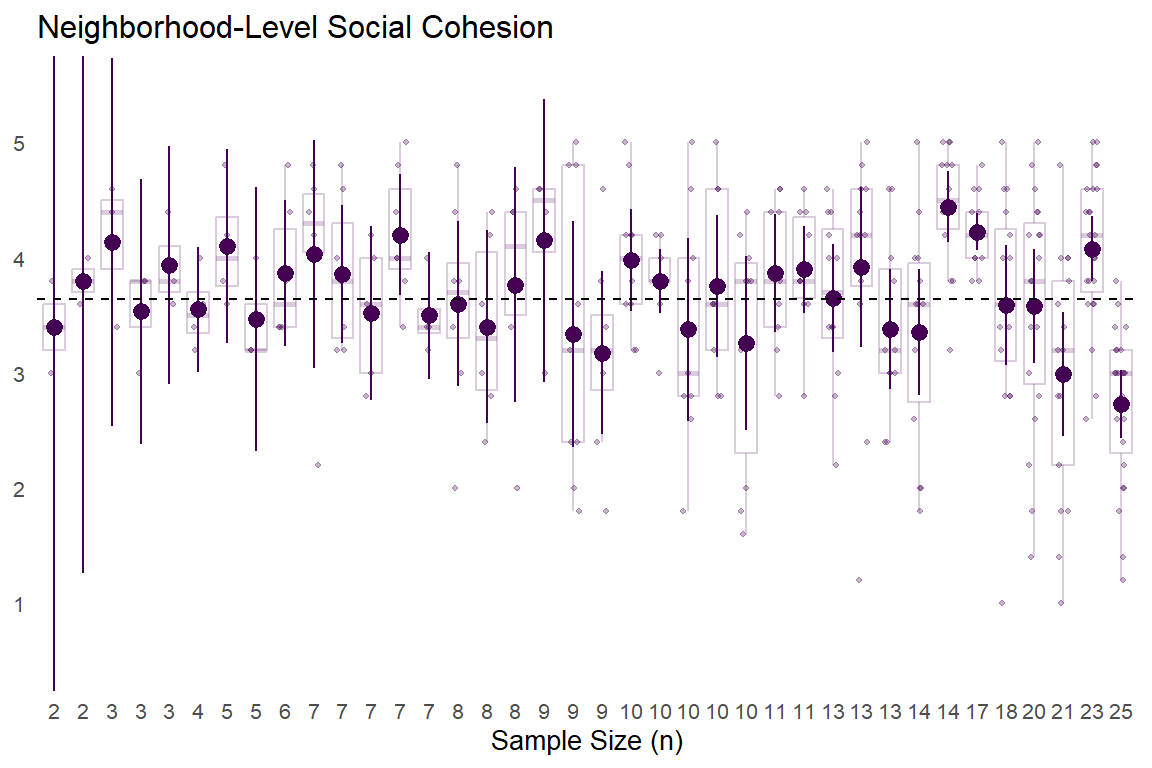
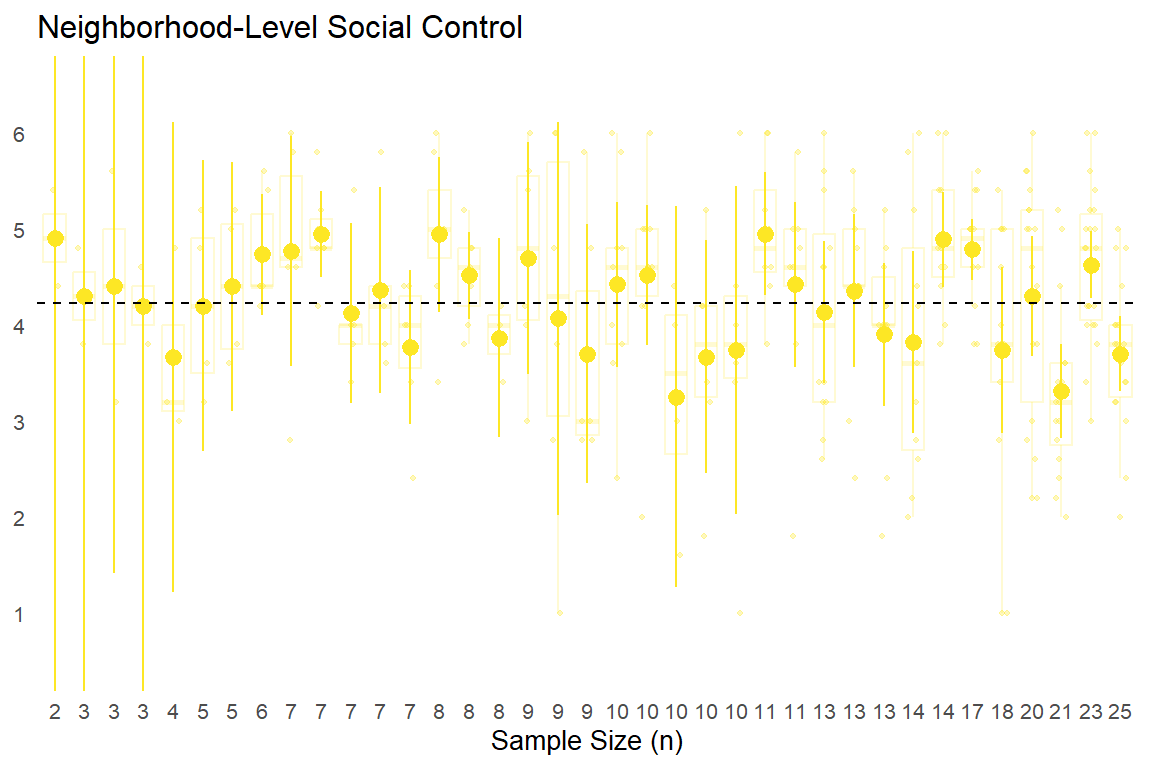
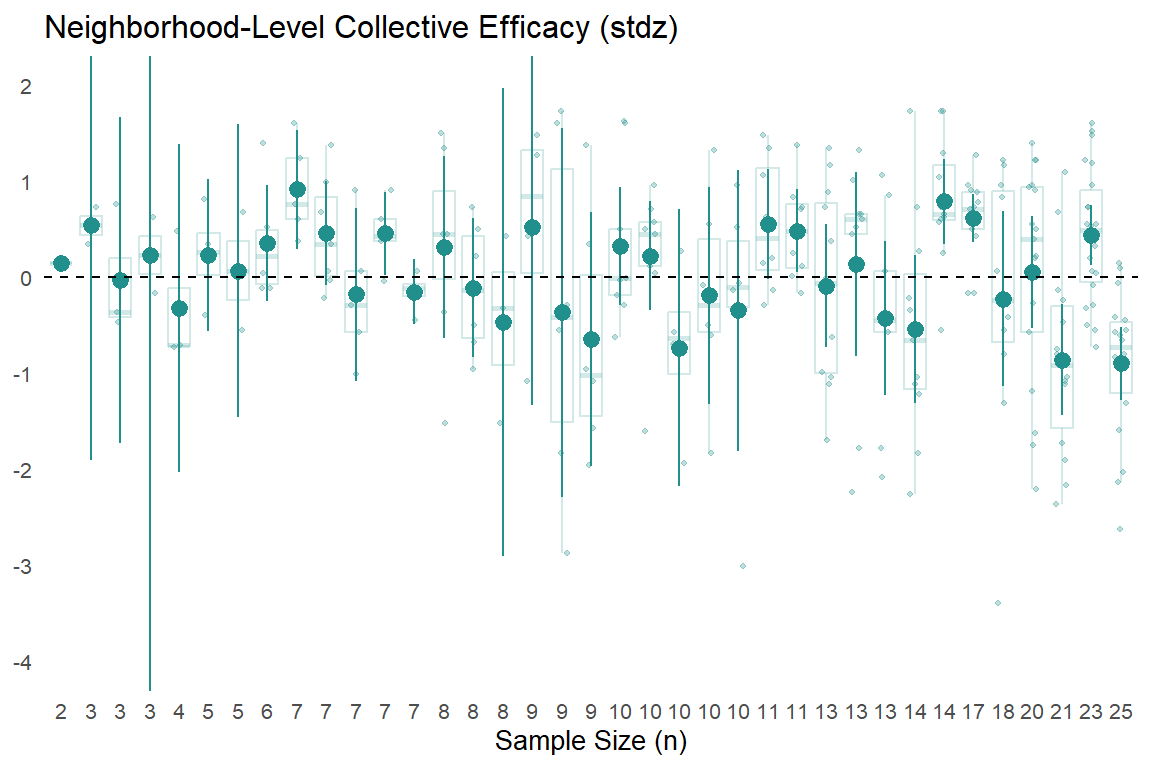
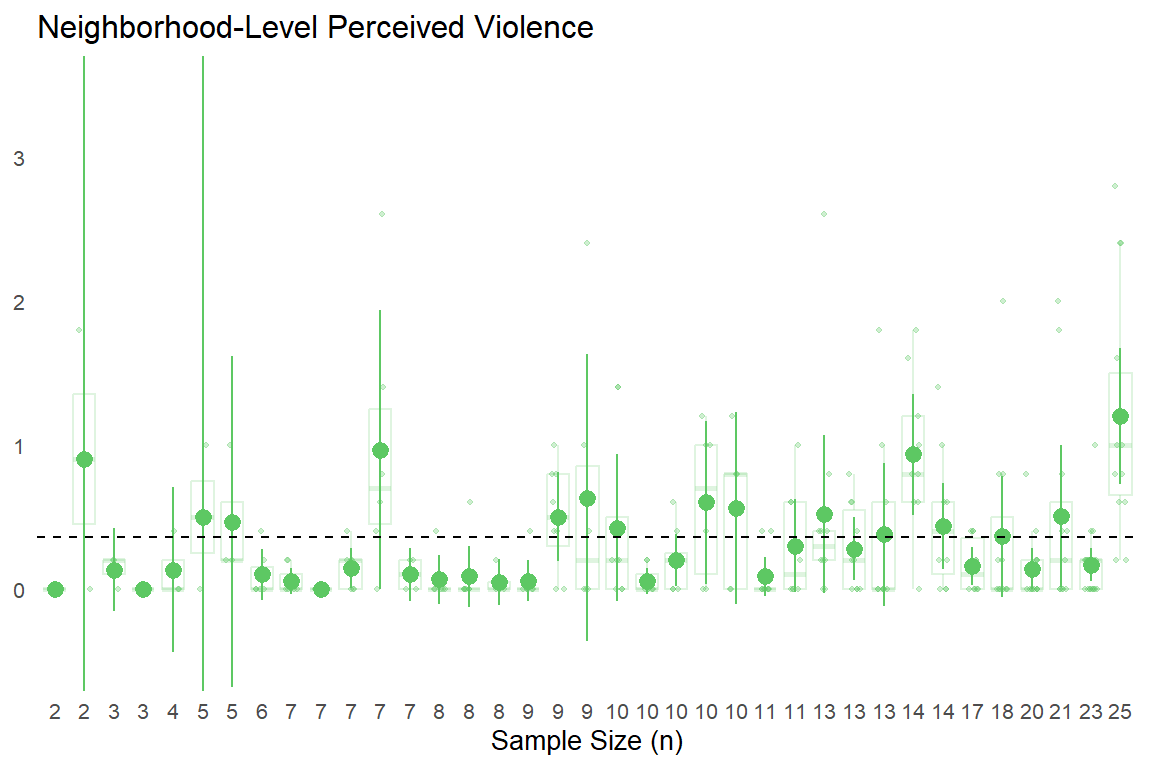
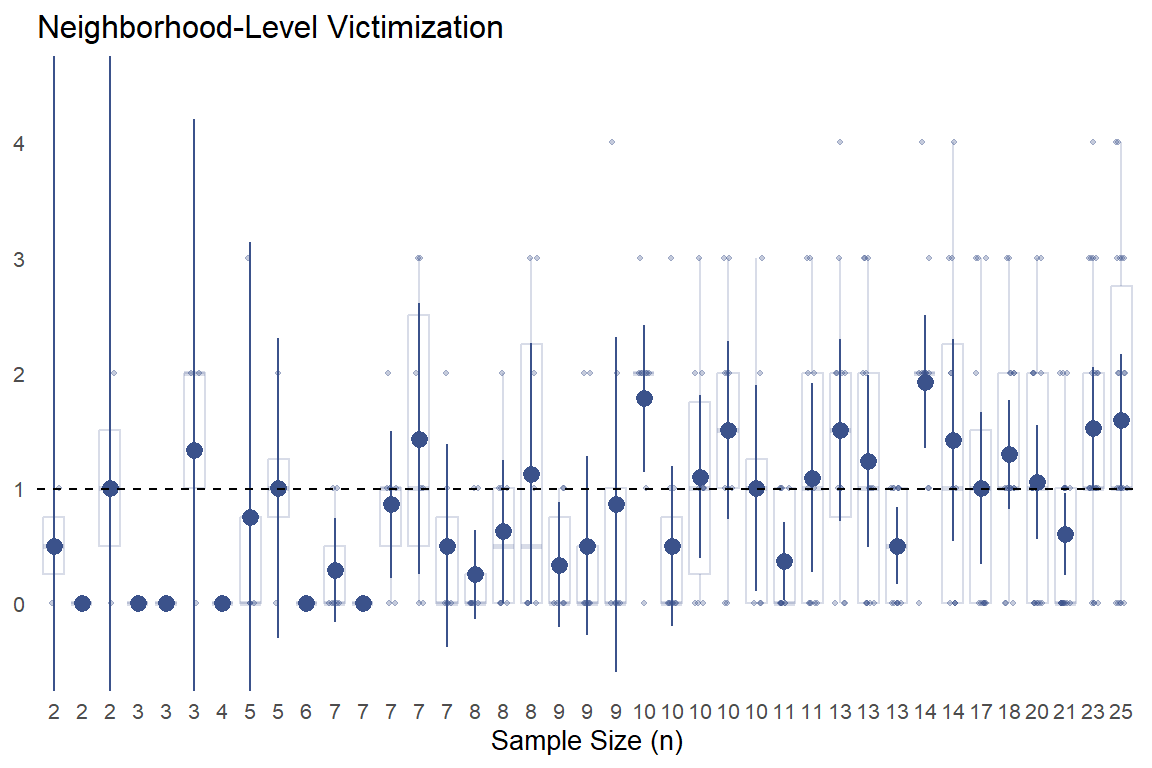
We can help build this intuition by plotting these mean values with their 95% confidence intervals based on a t-distribution.2 Additionally, we will show semi-transparent data points and box plots to visualize the degree of variation in individual responses used to comprise each aggregated neighborhood-level “observation.”

Show code
library(ggplot2)
library(dplyr)
library(rlang) # For {{ }} operator

### Neighborhood Plot Function
nbhd_plot <- function(
    data_agg,                   # Aggregated dataset (e.g., kc_combsurv_agganal)
    data_ind,                   # Indivdiual dataset for hline (e.g., kc_combsurv_ceanal)
    y_var,                      # Main y-variable (e.g., mean_cohesion)
    ymin_var,                   # Lower CI variable (e.g., low95ci_cohesion_tdist)
    ymax_var,                   # Upper CI variable (e.g., up95ci_cohesion_tdist)
    filter_na_var,              # Variable to check for NAs before filtering (e.g., sem_cohesion)
    hline_var_ind,              # Variable in raw data for hline (e.g., soc_cohesion)
    plot_title = NULL,                 # Title for the plot
    group_var = NBHD,           # Grouping variable for x-axis (defaults to NBHD)
    order_var = n,              # Variable to order by on x-axis (defaults to n)
    point_color = "black",  # Color for geom_pointrange
    y_axis_breaks = NULL,
    y_coord_limits = NULL,
    x_axis_title = NULL
) {

  # Prepare data for plotting (filtering and creating the n_lookup)
  plot_data <- data_agg %>%
    filter(!is.na({{ filter_na_var }}))

  # n_lookup needs to be created from the data that will be used in ggplot
  # and specifically from the 'group_var' and 'order_var' columns.
  # We need to ensure 'order_var' is treated as a symbol for creating the named vector.
  # This assumes 'group_var' and 'order_var' exist in 'plot_data'.
  # If 'order_var' is 'n', then this works.
  n_lookup_dynamic <- setNames(
    plot_data[[as_name(enquo(order_var))]], # Get the column specified by order_var
    plot_data[[as_name(enquo(group_var))]]  # Get the column specified by group_var
  )

  ggplot(plot_data, aes(x = reorder({{ group_var }}, {{ order_var }}), y = {{ y_var }})) +
    geom_pointrange(aes(ymin = {{ ymin_var }}, ymax = {{ ymax_var }}), color = point_color) +
    geom_hline(data = data_ind, aes(yintercept = mean({{ hline_var_ind }}, na.rm = TRUE)),
               linetype = 2) +
    scale_y_continuous(breaks = y_axis_breaks) +
    coord_cartesian(ylim = y_coord_limits) +
    scale_x_discrete(
      labels = function(x_breaks) {
        # x_breaks are the actual values from the 'group_var' column in their plotted order
        as.character(n_lookup_dynamic[x_breaks])
      },
      name = x_axis_title
    ) +
    theme_minimal(base_size = 10) +
    labs(title = plot_title) +
    theme(
      panel.grid = ggplot2::element_blank(),
      axis.title.y = ggplot2::element_blank()
    )
}

### Neighborhood Box Plot Function with Data Points & Mean Overlay
nbhd_box_plot <- function(
    data_agg,                   # Aggregated dataset (for means and CIs)
    data_ind,                   # Individual dataset for box plots and points
    y_var_ind,                  # Individual-level y-variable (e.g., soc_cohesion)
    y_var_agg,                  # Aggregated mean variable (e.g., mean_cohesion)
    ymin_var,                   # Lower CI variable (e.g., low95ci_cohesion_tdist)
    ymax_var,                   # Upper CI variable (e.g., up95ci_cohesion_tdist)
    filter_na_var,              # Variable to check for NAs before filtering
    hline_var_ind,              # Variable in raw data for hline
    plot_title = NULL,
    group_var = NBHD,
    order_var = n,
    box_color = "black",        # Box outline color
    box_alpha = 0.8,            # Box outline transparency
    point_color = "gray60",
    point_alpha = 0.4,
    point_size = 0.8,
    y_axis_breaks = NULL,
    y_coord_limits = NULL,
    x_axis_title = NULL
) {

  # Prepare aggregated data for ordering and means
  agg_data <- data_agg %>%
    filter(!is.na({{ filter_na_var }}))
  
  # Prepare individual data, filtering to neighborhoods in agg_data
  ind_data <- data_ind %>%
    filter({{ group_var }} %in% agg_data[[as_name(enquo(group_var))]]) %>%
    filter(!is.na({{ y_var_ind }}))
  
  # Create n_lookup for x-axis labels
  n_lookup_dynamic <- setNames(
    agg_data[[as_name(enquo(order_var))]],
    agg_data[[as_name(enquo(group_var))]]
  )
  
  # Get neighborhood order from aggregated data
  nbhd_order <- agg_data %>%
    arrange({{ order_var }}) %>%
    pull({{ group_var }})
  
  # Create the plot
  ggplot() +
    
    # Semi-transparent individual data points
    geom_point(data = ind_data,
               aes(x = factor({{ group_var }}, levels = nbhd_order), 
                   y = {{ y_var_ind }}),
               color = point_color, alpha = point_alpha, size = point_size,
               position = position_jitter(width = 0.2, height = 0)) +
    
    # Box plots with transparent fill
    geom_boxplot(data = ind_data,
                 aes(x = factor({{ group_var }}, levels = nbhd_order), 
                     y = {{ y_var_ind }}),
                 fill = "transparent", 
                 color = alpha(box_color, box_alpha),
                 outlier.shape = NA) +
    
    # Point-interval overlay (same color as box)
    geom_pointrange(data = agg_data,
                    aes(x = factor({{ group_var }}, levels = nbhd_order),
                        y = {{ y_var_agg }},
                        ymin = {{ ymin_var }}, 
                        ymax = {{ ymax_var }}),
                    color = box_color) +  # Same color as box outline
    
    # Overall mean horizontal line
    geom_hline(data = data_ind,
               aes(yintercept = mean({{ hline_var_ind }}, na.rm = TRUE)),
               linetype = 2) +
    
    scale_y_continuous(breaks = y_axis_breaks) +
    coord_cartesian(ylim = y_coord_limits) +
    scale_x_discrete(
      labels = function(x_breaks) {
        as.character(n_lookup_dynamic[x_breaks])
      },
      name = x_axis_title
    ) +
    theme_minimal(base_size = 10) +
    labs(title = plot_title) +
    theme(
      panel.grid = element_blank(),
      axis.title.y = element_blank()
    )
}
Show code
# Social Cohesion 
# nbhd_plot(data_agg = kc_combsurv_agganal,
#           data_ind = kc_combsurv_ceanal,
#           y_var = mean_cohesion,
#           ymin_var = low95ci_cohesion_tdist,
#           ymax_var = up95ci_cohesion_tdist,
#           filter_na_var = sem_cohesion,
#           hline_var_ind = soc_cohesion,
#           plot_title = "Neighborhood-Level Social Cohesion",
#           group_var = NBHD,
#           order_var = n,
#           point_color = "#440154FF",
#           y_axis_breaks = c(1,2,3,4,5),
#           y_coord_limits = c(0.5, 5.5),
#           x_axis_title = "Sample Size (n)"
# )

# Social Cohesion with mean overlay
nbhd_box_plot(
  data_agg = kc_combsurv_agganal, 
  data_ind = kc_combsurv_ceanal,
  y_var_ind = soc_cohesion,
  y_var_agg = mean_cohesion,
  ymin_var = low95ci_cohesion_tdist,
  ymax_var = up95ci_cohesion_tdist,
  filter_na_var = sem_cohesion,
  hline_var_ind = soc_cohesion,
  plot_title = "Neighborhood-Level Social Cohesion",
  box_color = "#440154FF",      # Same color for box and point-interval
  box_alpha = .2,
  point_color = "#440154FF",
  point_alpha = 0.3,
  y_axis_breaks = c(1,2,3,4,5),
  y_coord_limits = c(0.5, 5.5),
  x_axis_title = "Sample Size (n)"
)

Show code
# nbhd_plot(data_agg = kc_combsurv_agganal, 
#           data_ind = kc_combsurv_ceanal,
#           y_var = mean_control,
#           ymin_var = low95ci_control_tdist,
#           ymax_var = up95ci_control_tdist,
#           filter_na_var = sem_control,
#           hline_var_ind = soc_control,
#           plot_title = "Neighborhood-Level Social Control",
#           group_var = NBHD,
#           order_var = n,
#           point_color = "#FDE725FF",
#           y_axis_breaks = c(1,2,3,4,5,6),
#           y_coord_limits = c(0.5, 6.5),
#           x_axis_title = "Sample Size (n)"
# )

nbhd_box_plot(
  data_agg = kc_combsurv_agganal, 
  data_ind = kc_combsurv_ceanal,
  y_var_ind = soc_control,
  y_var_agg = mean_control,
  ymin_var = low95ci_control_tdist,
  ymax_var = up95ci_control_tdist,
  filter_na_var = sem_control,
  hline_var_ind = soc_control,
  plot_title = "Neighborhood-Level Social Control",
  box_color = "#FDE725FF",
  box_alpha = 0.2,
  point_color = "#FDE725FF",
  point_alpha = 0.3,
  y_axis_breaks = c(1,2,3,4,5,6),
  y_coord_limits = c(0.5, 6.5),
  x_axis_title = "Sample Size (n)"
)

Show code
# nbhd_plot(data_agg = kc_combsurv_agganal, 
#           data_ind = kc_combsurv_ceanal,
#           y_var = mean_coleffz,
#           ymin_var = low95ci_coleffz_tdist,
#           ymax_var = up95ci_coleffz_tdist,
#           filter_na_var = sem_coleffz,
#           hline_var_ind = coleff_z,
#           plot_title = "Neighborhood-Level Collective Efficacy",
#           group_var = NBHD,
#           order_var = n,
#           point_color = "#21908CFF",
#           y_axis_breaks = c(-4,-3,-2,-1,0,1,2),
#           y_coord_limits = c(-4, 2),
#           x_axis_title = "Sample Size (n)"
# )

nbhd_box_plot(
  data_agg = kc_combsurv_agganal, 
  data_ind = kc_combsurv_ceanal,
  y_var_ind = coleff_z,
  y_var_agg = mean_coleffz,
  ymin_var = low95ci_coleffz_tdist,
  ymax_var = up95ci_coleffz_tdist,
  filter_na_var = sem_coleffz,
  hline_var_ind = coleff_z,
  plot_title = "Neighborhood-Level Collective Efficacy (stdz)",
  box_color = "#21908CFF",
  box_alpha = 0.2,
  point_color = "#21908CFF",
  point_alpha = 0.3,
  y_axis_breaks = c(-4,-3,-2,-1,0,1,2),
  y_coord_limits = c(-4, 2),
  x_axis_title = "Sample Size (n)"
)

Show code
# nbhd_plot(data_agg = kc_combsurv_agganal, 
#           data_ind = kc_combsurv_ceanal,
#           y_var = mean_percviol,
#           ymin_var = low95ci_percviol_tdist,
#           ymax_var = up95ci_percviol_tdist,
#           filter_na_var = sem_percviol,
#           hline_var_ind = percviol,
#           plot_title = "Neighborhood-Level Perceived Violence",
#           group_var = NBHD,
#           order_var = n,
#           point_color = "#5DC863FF",
#           y_axis_breaks = c(0,1,2,3),
#           y_coord_limits = c(-0.5, 3.5),
#           x_axis_title = "Sample Size (n)"
# )

nbhd_box_plot(
  data_agg = kc_combsurv_agganal, 
  data_ind = kc_combsurv_ceanal,
  y_var_ind = percviol,
  y_var_agg = mean_percviol,
  ymin_var = low95ci_percviol_tdist,
  ymax_var = up95ci_percviol_tdist,
  filter_na_var = sem_percviol,
  hline_var_ind = percviol,
  plot_title = "Neighborhood-Level Perceived Violence",
  box_color = "#5DC863FF",
  box_alpha = 0.2,
  point_color = "#5DC863FF",
  point_alpha = 0.3,
  y_axis_breaks = c(0,1,2,3),
  y_coord_limits = c(-0.5, 3.5),
  x_axis_title = "Sample Size (n)"
)

Show code
# nbhd_plot(data_agg = kc_combsurv_agganal, 
#           data_ind = kc_combsurv_ceanal,
#           y_var = mean_expcrime,
#           ymin_var = low95ci_expcrime_tdist,
#           ymax_var = up95ci_expcrime_tdist,
#           filter_na_var = sem_expcrime,
#           hline_var_ind = expcrime,
#           plot_title = "Neighborhood-Level Victimization",
#           group_var = NBHD,
#           order_var = n,
#           point_color = "#3B528BFF",
#           y_axis_breaks = c(0,1,2,3,4),
#           y_coord_limits = c(-0.5, 4.5),
#           x_axis_title = "Sample Size (n)"
# )

nbhd_box_plot(
  data_agg = kc_combsurv_agganal, 
  data_ind = kc_combsurv_ceanal,
  y_var_ind = expcrime,
  y_var_agg = mean_expcrime,
  ymin_var = low95ci_expcrime_tdist,
  ymax_var = up95ci_expcrime_tdist,
  filter_na_var = sem_expcrime,
  hline_var_ind = expcrime,
  plot_title = "Neighborhood-Level Victimization",
  box_color = "#3B528BFF",
  box_alpha = 0.2,
  point_color = "#3B528BFF",
  point_alpha = 0.3,
  y_axis_breaks = c(0,1,2,3,4),
  y_coord_limits = c(-0.5, 4.5),
  x_axis_title = "Sample Size (n)"
)

In the above plots, the point-intervals clearly show the inverse relationship between sub-sample size and uncertainty in estimates as expected, with extremely wide 95% CIs for aggregated neighborhood estimates comprised of a few responses (left side of each plot) that tend to narrow substantially as the number of observations per neighborhood increases.

With that said, the semi-transparent data point spreads and box plot widths behind the point-intervals also shows that the increased “certainty” presumably gained via larger sample sizes masks substantial within-neighborhood heterogeneity in individual responses. You can also see some of the limits in trying to estimate uncertainty from the observed data, especially with the neighborhood-level victimization. For some small sub-samples, (e.g., n = 2 - 7), everyone surveyed in that neighborhood reported no experiences with criminal victimization and thus, there are no uncertainty estimates. We could estimate a simple multilevel model to get more reasonable (and more conservative) uncertainty estimates, but we’ll forgo that for now in order to actually map these values.

6.0.5 Mapping Survey Data

Since the aggregate survey data above only has the sampled neighborhoods, we first need to merge the data with the full crime date data.

Show code
kc_combsurv_agganal_sf <- kc_combsurv_agganal %>%
  full_join(kc_combsurv_geoid) %>%
  st_sf()

We can start by plotting some basic descriptive maps. First, let’s plot the number of respondents for each neighborhood sampled.

Show code
nsamp_pal <- colorNumeric(palette = "viridis",
                          domain = c(1, 25),
                          reverse = TRUE,
                          na.color = "white")

# Get the bounding box of your data

surv_response_map <- 
leaflet(kc_combsurv_agganal_sf) %>%
  addProviderTiles(providers$CartoDB.Positron) %>%  # Add Positron map tiles
  setView(lng = -94.5786, lat = 39.0997, zoom = 10) %>%  # KC coordinates  
  addPolygons(
    fillColor = ~nsamp_pal(pmin(n, 25)),
    weight = 1,
    opacity = 1,
    color = "black",
    dashArray = "",
    fillOpacity = 0.5,
    highlight = highlightOptions(
      weight = 3,
      color = "#666",
      dashArray = "",
      fillOpacity = 0.5,
      bringToFront = TRUE),
    popup = ~paste("<b>Neighborhood Information</b>",
                   "<br>Neighborhood:", NBHNAME,
                   "<br>Population (2020):", SUM_POP20,
                   "<br>Sample:", sample_fact,
                   "<br>Violent Crime (per 1,000):", VC_1000_Rate,
                   "<br>Property Crime (per 1,000):", PC_1000_Rate,
                   "<br>Total Crime (per 1,000):", Crime_1000_Rate,
                   "<hr><b>Survey Information</b>",
                   "<br>Survey Respondents:", n
                   ),
    label = ~NBHNAME
  ) %>%
  # fitBounds(lng1 = bbox[1], lat1 = bbox[2], 
  #           lng2 = bbox[3], lat2 = bbox[4]) %>%  
  addLegend(pal = nsamp_pal, 
            values = c(1, 25), 
            opacity = 0.7, 
            title = "Survey Respondents",
            position = "bottomright")

surv_response_map
Show code
saveWidget(surv_response_map, file = here("maps", "surv_response_map.html"))

Next, we can plot our scales and subscales at the neighborhood level. Of course, readers should consider the above differences in (sub)sample sizes and within-neighborhood variability (as well as item-level heterogeneity) observed previously when considering the reliability of these aggregate estimates.

Show code
cohesion_pal <- colorNumeric(palette = "viridis",
                          domain = c(1, 5),
                          reverse = TRUE,
                          na.color = "white")

# Get the bounding box of your data
surv_cohesion_map <- 
leaflet(kc_combsurv_agganal_sf) %>%
  addProviderTiles(providers$CartoDB.Positron) %>%  # Add Positron map tiles
  setView(lng = -94.5786, lat = 39.0997, zoom = 10) %>%  # KC coordinates  
  addPolygons(
    fillColor = ~cohesion_pal(pmin(mean_cohesion, 5)),
    weight = 1,
    opacity = 1,
    color = "black",
    dashArray = "",
    fillOpacity = 0.5,
    highlight = highlightOptions(
      weight = 3,
      color = "#666",
      dashArray = "",
      fillOpacity = 0.5,
      bringToFront = TRUE),
    popup = ~paste("<b>Neighborhood Information</b>",
                   "<br>Neighborhood:", NBHNAME,
                   "<br>Population (2020):", SUM_POP20,
                   "<br>Sample:", sample_fact,
                   "<br>Violent Crime (per 1,000):", VC_1000_Rate,
                   "<br>Property Crime (per 1,000):", PC_1000_Rate,
                   "<br>Total Crime (per 1,000):", Crime_1000_Rate,
                   "<hr><b>Survey Information</b>",
                   "<br>Survey Respondents:", n,
                   "<br>Social Cohesion:", round(mean_cohesion, 2),
                   "<br>Social Control:", round(mean_control, 2),
                   "<br>Collective Efficacy:", round(mean_coleffz, 2),
                   "<br>Perceived Violence:", round(mean_percviol, 2),
                   "<br>Exp. Criminal Victimization:", round(mean_expcrime, 2)
                   ),    
    label = ~NBHNAME
    ) %>%
  addLegend(pal = cohesion_pal, 
            values = c(1, 5), 
            opacity = 0.7, 
            title = "Social Cohesion",
            position = "bottomright")
surv_cohesion_map
Show code
saveWidget(surv_cohesion_map, file = here("maps", "surv_cohesion_map.html"))
Show code
control_pal <- colorNumeric(palette = "viridis",
                          domain = c(1, 6),
                          reverse = TRUE,
                          na.color = "white")

# Get the bounding box of your data
surv_control_map <- 
leaflet(kc_combsurv_agganal_sf) %>%
  addProviderTiles(providers$CartoDB.Positron) %>%  # Add Positron map tiles
  setView(lng = -94.5786, lat = 39.0997, zoom = 10) %>%  # KC coordinates  
  addPolygons(
    fillColor = ~control_pal(pmin(mean_control, 6)),
    weight = 1,
    opacity = 1,
    color = "black",
    dashArray = "",
    fillOpacity = 0.5,
    highlight = highlightOptions(
      weight = 3,
      color = "#666",
      dashArray = "",
      fillOpacity = 0.5,
      bringToFront = TRUE),
    popup = ~paste("<b>Neighborhood Information</b>",
                   "<br>Neighborhood:", NBHNAME,
                   "<br>Population (2020):", SUM_POP20,
                   "<br>Sample:", sample_fact,
                   "<br>Violent Crime (per 1,000):", VC_1000_Rate,
                   "<br>Property Crime (per 1,000):", PC_1000_Rate,
                   "<br>Total Crime (per 1,000):", Crime_1000_Rate,
                   "<hr><b>Survey Information</b>",
                   "<br>Survey Respondents:", n,
                   "<br>Social Cohesion:", round(mean_cohesion, 2),
                   "<br>Social Control:", round(mean_control, 2),
                   "<br>Collective Efficacy:", round(mean_coleffz, 2),
                   "<br>Perceived Violence:", round(mean_percviol, 2),
                   "<br>Exp. Criminal Victimization:", round(mean_expcrime, 2)
                   ),    
    label = ~NBHNAME
  ) %>%
  addLegend(pal = control_pal, 
            values = c(1, 6), 
            opacity = 0.7, 
            title = "Social Control",
            position = "bottomright")
surv_control_map
Show code
saveWidget(surv_control_map, file = here("maps", "surv_control_map.html"))
Show code
coleff_pal <- colorNumeric(palette = "viridis",
                          domain = c(-3.5, 2),
                          reverse = TRUE,
                          na.color = "white")

# Get the bounding box of your data
surv_coleff_map <- 
leaflet(kc_combsurv_agganal_sf) %>%
  addProviderTiles(providers$CartoDB.Positron) %>%  # Add Positron map tiles
  setView(lng = -94.5786, lat = 39.0997, zoom = 10) %>%  # KC coordinates  
  addPolygons(
    fillColor = ~coleff_pal(pmin(mean_coleffz, 2)),
    weight = 1,
    opacity = 1,
    color = "black",
    dashArray = "",
    fillOpacity = 0.5,
    highlight = highlightOptions(
      weight = 3,
      color = "#666",
      dashArray = "",
      fillOpacity = 0.5,
      bringToFront = TRUE),
    popup = ~paste("<b>Neighborhood Information</b>",
                   "<br>Neighborhood:", NBHNAME,
                   "<br>Population (2020):", SUM_POP20,
                   "<br>Sample:", sample_fact,
                   "<br>Violent Crime (per 1,000):", VC_1000_Rate,
                   "<br>Property Crime (per 1,000):", PC_1000_Rate,
                   "<br>Total Crime (per 1,000):", Crime_1000_Rate,
                   "<hr><b>Survey Information</b>",
                   "<br>Survey Respondents:", n,
                   "<br>Social Cohesion:", round(mean_cohesion, 2),
                   "<br>Social Control:", round(mean_control, 2),
                   "<br>Collective Efficacy:", round(mean_coleffz, 2),
                   "<br>Perceived Violence:", round(mean_percviol, 2),
                   "<br>Exp. Criminal Victimization:", round(mean_expcrime, 2)
                   ),    
    label = ~NBHNAME
  ) %>%
  addLegend(pal = coleff_pal, 
            values = c(-3.5, 2), 
            opacity = 0.7, 
            title = "Collective Efficacy<br>(Standardized Scale)",
            position = "bottomright")
surv_coleff_map
Show code
saveWidget(surv_coleff_map, file = here("maps", "surv_coleff_map.html"))
Show code
percviol_pal <- colorNumeric(palette = "viridis",
                          domain = c(0, 3),
                          reverse = TRUE,
                          na.color = "white")

# Get the bounding box of your data
surv_percviol_map <- 
leaflet(kc_combsurv_agganal_sf) %>%
  addProviderTiles(providers$CartoDB.Positron) %>%  # Add Positron map tiles
  setView(lng = -94.5786, lat = 39.0997, zoom = 10) %>%  # KC coordinates  
  addPolygons(
    fillColor = ~percviol_pal(pmin(mean_percviol, 3)),
    weight = 1,
    opacity = 1,
    color = "black",
    dashArray = "",
    fillOpacity = 0.5,
    highlight = highlightOptions(
      weight = 3,
      color = "#666",
      dashArray = "",
      fillOpacity = 0.5,
      bringToFront = TRUE),
    popup = ~paste("<b>Neighborhood Information</b>",
                   "<br>Neighborhood:", NBHNAME,
                   "<br>Population (2020):", SUM_POP20,
                   "<br>Sample:", sample_fact,
                   "<br>Violent Crime (per 1,000):", VC_1000_Rate,
                   "<br>Property Crime (per 1,000):", PC_1000_Rate,
                   "<br>Total Crime (per 1,000):", Crime_1000_Rate,
                   "<hr><b>Survey Information</b>",
                   "<br>Survey Respondents:", n,
                   "<br>Social Cohesion:", round(mean_cohesion, 2),
                   "<br>Social Control:", round(mean_control, 2),
                   "<br>Collective Efficacy:", round(mean_coleffz, 2),
                   "<br>Perceived Violence:", round(mean_percviol, 2),
                   "<br>Exp. Criminal Victimization:", round(mean_expcrime, 2)
                   ),    
    label = ~NBHNAME
  ) %>%
  addLegend(pal = percviol_pal, 
            values = c(0, 3), 
            opacity = 0.7, 
            title = "Perceived Neigh. Violence",
            position = "bottomright")
surv_percviol_map
Show code
saveWidget(surv_percviol_map, file = here("maps", "surv_percviol_map.html"))
Show code
expcrime_pal <- colorNumeric(palette = "viridis",
                          domain = c(0, 4),
                          reverse = TRUE,
                          na.color = "white")

# Get the bounding box of your data
surv_expcrime_map <- 
leaflet(kc_combsurv_agganal_sf) %>%
  addProviderTiles(providers$CartoDB.Positron) %>%  # Add Positron map tiles
  setView(lng = -94.5786, lat = 39.0997, zoom = 10) %>%  # KC coordinates  
  addPolygons(
    fillColor = ~expcrime_pal(pmin(mean_expcrime, 4)),
    weight = 1,
    opacity = 1,
    color = "black",
    dashArray = "",
    fillOpacity = 0.5,
    highlight = highlightOptions(
      weight = 3,
      color = "#666",
      dashArray = "",
      fillOpacity = 0.5,
      bringToFront = TRUE),
    popup = ~paste("<b>Neighborhood Information</b>",
                   "<br>Neighborhood:", NBHNAME,
                   "<br>Population (2020):", SUM_POP20,
                   "<br>Sample:", sample_fact,
                   "<br>Violent Crime (per 1,000):", VC_1000_Rate,
                   "<br>Property Crime (per 1,000):", PC_1000_Rate,
                   "<br>Total Crime (per 1,000):", Crime_1000_Rate,
                   "<hr><b>Survey Information</b>",
                   "<br>Survey Respondents:", n,
                   "<br>Social Cohesion:", round(mean_cohesion, 2),
                   "<br>Social Control:", round(mean_control, 2),
                   "<br>Collective Efficacy:", round(mean_coleffz, 2),
                   "<br>Perceived Violence:", round(mean_percviol, 2),
                   "<br>Exp. Criminal Victimization:", round(mean_expcrime, 2)
                   ),    
    label = ~NBHNAME
  ) %>%
  addLegend(pal = expcrime_pal, 
            values = c(0, 4), 
            opacity = 0.7, 
            title = "Average Exp. Criminal<br>Victimization",
            position = "bottomright")
surv_expcrime_map
Show code
saveWidget(surv_expcrime_map, file = here("maps", "surv_expcrime_map.html"))

6.0.6 Bivariate choropleth maps

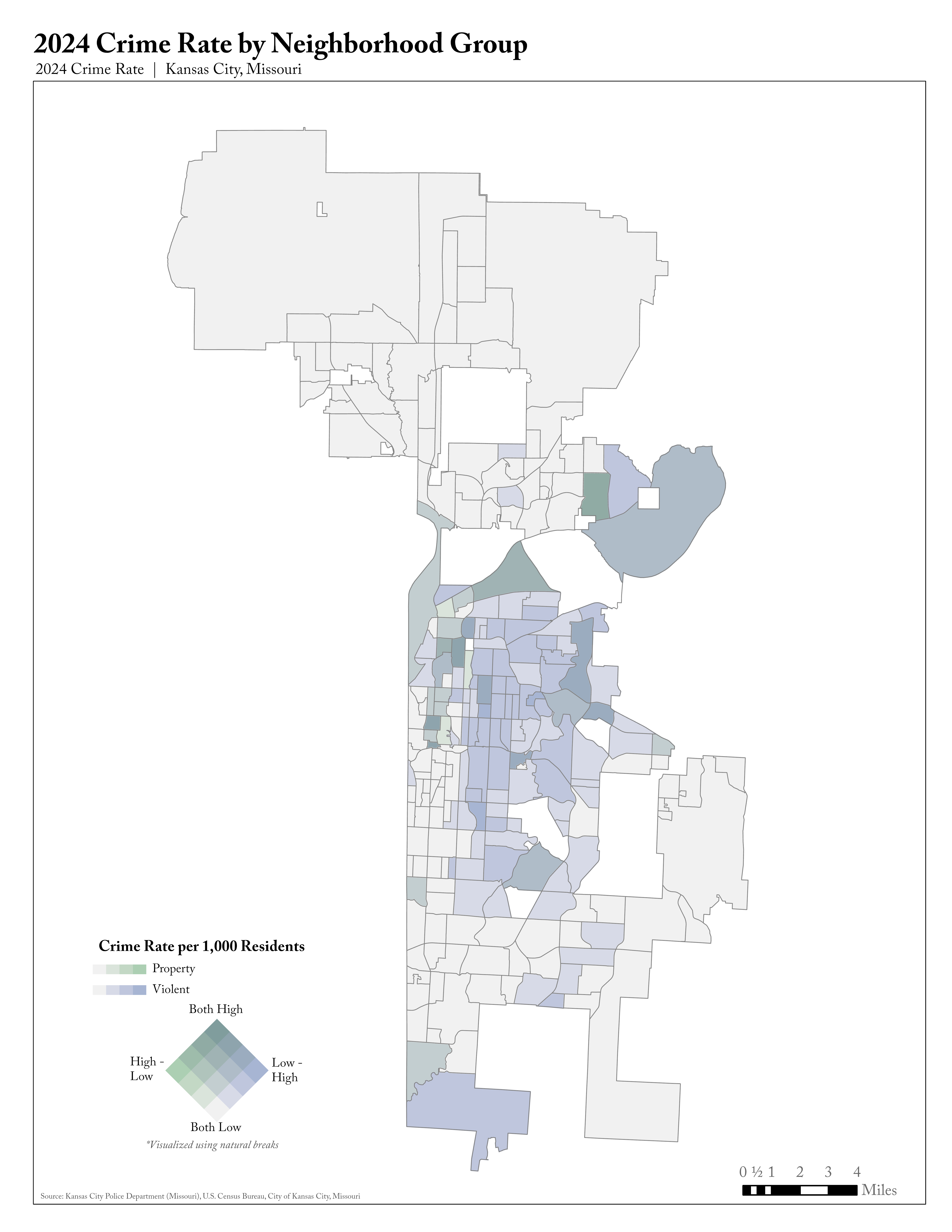
The choropleth maps shown above are useful for looking at the distribution of single variables across neighborhoods. But, as documented at the individual-level in the previous chapter, we are primarily interested in how collective efficacy is related to crime-relevant variables. If we want to map bivariate relationships, we need to create a bivariate choropleth map. Logan already did this with the crime rate data by plotting both violent and property crime on the same map:

Logan’s Bivariate Choropleth

Logan’s Bivariate Choropleth

Note that Logan uses “natural breaks” to classify neighborhoods on the 16-category two-dimensional scale. Our understanding is that this is a data-driven approach where natural breakpoints are found that minimize within-class variance. It is also our understanding that this is less common than quantile breaks (dividing data into a specified number of equal groups) in practice but also probably more appropriate given it relies on finding actual clusters in the data. We will use less precise (e.g., 9-category scale) and less sophisticated methods (e.g., quantile classification) in attempting to construct similar bivariate choropleth maps using the survey data.

Show code
# library(dplyr)
# library(biscale)

biclass_palfactor <- function(data, x_var, y_var, style = "quantile", dim = 3, keep_factors = TRUE) {
  
  # Check if necessary packages are loaded
  if (!requireNamespace("dplyr", quietly = TRUE)) {
    stop("Package 'dplyr' is needed. Please install and load it.", call. = FALSE)
  }
  if (!requireNamespace("biscale", quietly = TRUE)) {
    stop("Package 'biscale' is needed. Please install and load it.", call. = FALSE)
  }
  
  # Create a temporary data frame with renamed columns
  temp_data <- data
  temp_data$x_temp <- data[[x_var]]
  temp_data$y_temp <- data[[y_var]]
  
  # Call bi_class with the temporary column names
  biclass_data <- bi_class(.data = temp_data, 
                           x = x_temp, 
                           y = y_temp, 
                           style = style, 
                           dim = dim,
                           keep_factors = keep_factors) %>%
    select(-x_temp, -y_temp)  # Remove temporary columns
  
  # 2. Systematically generate expected_levels based on dim_val
  level_combinations <- expand.grid(x_cat = 1:dim, y_cat = 1:dim)
  expected_levels <- paste(level_combinations$x_cat, level_combinations$y_cat, sep = "-")
  
  # 3. Process the "bi_class" column (which was created by biscale::bi_class)
  data_processed <- biclass_data %>%
    dplyr::mutate(
      bi_class = ifelse(as.character(bi_class) == "NA-NA", NA_character_, as.character(bi_class)),
      bi_class = factor(bi_class, levels = expected_levels)
    )
  
  return(data_processed)
}
Show code
library(htmltools) # Ensure htmltools is loaded

bivariate_legend <- function(palette_name,
                             dim = 3,
                             legend_title = NULL, # Optional title for the legend
                             x_var_label = "x var",
                             y_var_label = "y var",
                             cell_size = 22,
                             font_size = "11px",
                             show_na_legend = FALSE,
                             na_color = "white",
                             na_label = "Data Missing") {

  colors_vector <- bi_pal(pal = palette_name, dim = dim, preview = FALSE)
  color_matrix <- matrix(colors_vector, nrow = dim, byrow = TRUE)

  legend_html <- sprintf(
    "<div style='font-family: Arial, sans-serif; font-size: %s; display: inline-block; line-height: 1.2; background: rgba(255,255,255,0.8); padding: 8px; border-radius: 4px; box-shadow: 0 0 8px rgba(0,0,0,0.15);'>",
    font_size
  )
  
  # --- Optional Title with Multi-line Support ---
  if (!is.null(legend_title) && nzchar(trimws(legend_title))) {
    # 1. Escape HTML special characters from the raw title first
    escaped_title <- htmltools::htmlEscape(legend_title)
    # 2. Convert newline characters (\n) in the escaped title to <br /> tags
    #    gsub fixed = TRUE is generally safer for simple string replacement.
    multiline_title_html <- gsub("\n", "<br />", escaped_title, fixed = TRUE)
    
    legend_html <- paste0(
      legend_html,
      sprintf(
        "<div style='text-align: center; font-weight: bold; margin-bottom: 6px; font-size: %s;'>%s</div>",
        font_size, 
        multiline_title_html # Use the processed title with <br /> tags
      )
    )
  }
  # --- End of Optional Title ---
  
  legend_html <- paste0(legend_html, "<table style='border-collapse: collapse;'>")
  legend_html <- paste0(legend_html, "<tr>")
  
  legend_html <- paste0(legend_html, "<td style='text-align: center; vertical-align: middle; padding-right: 8px;'>")
  legend_html <- paste0(legend_html, "<div><span style='font-size:1.4em;'>&uarr;</span></div>")
  legend_html <- paste0(legend_html, "<div style='writing-mode: vertical-rl; transform: rotate(180deg); white-space: nowrap; margin-top: 4px;'>")
  legend_html <- paste0(legend_html, htmltools::htmlEscape(y_var_label))
  legend_html <- paste0(legend_html, "</div>")
  legend_html <- paste0(legend_html, "</td>")
  
  legend_html <- paste0(legend_html, "<td>")
  legend_html <- paste0(legend_html, "<table style='border-collapse: collapse; border-spacing: 0;'>")
  
  for (i in dim:1) {
    legend_html <- paste0(legend_html, "<tr>")
    for (j in 1:dim) {
      current_color <- color_matrix[i, j]
      legend_html <- paste0(
        legend_html,
        sprintf("<td style='width: %dpx; height: %dpx; background-color:%s; border: 1px solid #fff;'></td>", cell_size, cell_size, current_color)
      )
    }
    legend_html <- paste0(legend_html, "</tr>")
  }
  legend_html <- paste0(legend_html, "</table></td>")
  legend_html <- paste0(legend_html, "</tr>")
  
  legend_html <- paste0(legend_html, "<tr>")
  legend_html <- paste0(legend_html, "<td></td>")
  legend_html <- paste0(
    legend_html,
    "<td style='text-align: center; vertical-align: top; padding-top: 5px;'>",
    htmltools::htmlEscape(x_var_label), " <span style='font-size:1.4em;'>&rarr;</span>",
    "</td>"
  )
  legend_html <- paste0(legend_html, "</tr>")
  legend_html <- paste0(legend_html, "</table>")

  if (show_na_legend && !is.null(na_color) && !is.null(na_label)) {
    legend_html <- paste0(legend_html, "<div style='margin-top: 8px; text-align: left;'>")
    legend_html <- paste0(legend_html, sprintf("<span style='display:inline-block; width: %dpx; height: %dpx; background-color:%s; border: 1px solid #ccc; vertical-align: middle; margin-right: 4px;'></span>", cell_size * 0.6, cell_size * 0.6, na_color))
    legend_html <- paste0(legend_html, "<span style='vertical-align: middle;'>", htmltools::htmlEscape(na_label), "</span>")
    legend_html <- paste0(legend_html, "</div>")
  }
  
  legend_html <- paste0(legend_html, "</div>")
  
  return(HTML(legend_html))
}
Show code
bivariate_leaflet_map <- function(data,
                                  x_var,
                                  y_var,
                                  x_label,
                                  y_label,
                                  palette = "DkCyan2",
                                  dim = 3,
                                  center_lng = -94.5786,
                                  center_lat = 39.0997,
                                  zoom = 10,
                                  legend_title = "Bivariate Classification",
                                  popup_content = NULL,
                                  label_col = "NBHNAME",
                                  na_color = "white",
                                  na_label = "Data Missing",
                                  cell_size = 30,
                                  font_size = "10px") {
  
  # Check if necessary packages are loaded
  if (!requireNamespace("leaflet", quietly = TRUE)) {
    stop("Package 'leaflet' is needed. Please install it.", call. = FALSE)
  }
  if (!requireNamespace("biscale", quietly = TRUE)) {
    stop("Package 'biscale' is needed. Please install it.", call. = FALSE)
  }
  
  # Input validation
  required_cols <- c("bi_class")
  if (!is.null(label_col)) {
    required_cols <- c(required_cols, label_col)
  }
  
  missing_cols <- required_cols[!required_cols %in% names(data)]
  if (length(missing_cols) > 0) {
    stop(paste("Missing required columns:", paste(missing_cols, collapse = ", ")), 
         call. = FALSE)
  }
  
  # Create default popup if none provided
  if (is.null(popup_content)) {
    popup_content <- ~paste(
      "<strong>Bivariate Class:</strong>", bi_class,
      "<br><strong>", y_label, ":</strong>", round(get(y_var), 2),
      "<br><strong>", x_label, ":</strong>", round(get(x_var), 2)
    )
  }
  
  # Create bivariate color palette
  biv_colors <- bi_pal(pal = palette, dim = dim, preview = FALSE)
  
  # Create color function
  palfun <- colorFactor(palette = biv_colors, 
                        domain = levels(data$bi_class), 
                        na.color = na_color, 
                        ordered = TRUE)
  
  # Create the base map
  biv_map <- leaflet(data) %>%
    addProviderTiles(providers$CartoDB.Positron, group = "Basemap") %>%
    setView(lng = center_lng, lat = center_lat, zoom = zoom) %>%
    addPolygons(
      fillColor = ~palfun(bi_class),
      weight = 1,
      opacity = 1,
      color = "black",
      dashArray = "",
      fillOpacity = 0.7,
      highlight = highlightOptions(
        weight = 3,
        color = "#666",
        dashArray = "",
        fillOpacity = 0.8,
        bringToFront = TRUE
      ),
      popup = popup_content,
      label = if (!is.null(label_col)) ~get(label_col) else NULL,
      group = "Crime Rates"
    )
  
  # Generate the legend
  legend_html <- bivariate_legend(
    palette_name = palette,
    dim = dim,
    legend_title = legend_title,
    x_var_label = x_label,
    y_var_label = y_label,
    cell_size = cell_size,
    font_size = font_size,
    show_na_legend = TRUE,
    na_color = na_color,
    na_label = na_label
  )
  
  # Add legend to map
  final_map <- biv_map %>%
    addControl(html = legend_html, position = "bottomright")
  
  return(final_map)
}

We ended up creating some custom functions that will produce similar plots to the univariate choropleths above but that show bivariate relationships.

6.0.6.1 Crime Rates

The first thing we can do is reproduce the basic idea of Logan’s plot above by plotting violent and property crime on the same map.

Show code
# Classify neighborhoods
biv_crime <- biclass_palfactor(data = kc_combsurv_agganal_sf,
                               x_var = "PC_1000_Rate",
                               y_var = "VC_1000_Rate",
                               dim = 3)

# Define custom popup
## Neighborhood Data
nbhd_popup <- ~paste(
  "<b>Neighborhood Information</b>",
  "<br>Neighborhood:", NBHNAME,
  "<br>Population (2020):", SUM_POP20,
  "<br>Sample:", sample_fact,
  "<br>Bivariate Class:", bi_class,
  "<br>Property Crime Class:", bi_x,
  "<br>Violent Crime Class:", bi_y,
  "<br>Violent Crime (per 1,000):", round(VC_1000_Rate, 2),
  "<br>Property Crime (per 1,000):", round(PC_1000_Rate, 2),
  "<br>Total Crime (per 1,000):", round(Crime_1000_Rate, 2)
)

crime_bivmap <- bivariate_leaflet_map(
  data = biv_crime,
  x_var = "PC_1000_Rate",
  y_var = "VC_1000_Rate", 
  x_label = "Property Crime",
  y_label = "Violent Crime",
  palette = "DkBlue2",
  legend_title = "Property by Violent Crime\n (rate per 1,000)",
  popup_content = nbhd_popup,
  label_col = NULL
)

crime_bivmap


It may be interesting to compare the bivariate crime map with the univariate total crime. The neighborhoods classified as both high property and high crime rate (3-3) will obviously have higher total crime, but there may be some neighborhoods where property crime is driving their relatively high crime rates.

Show code
totcrime_map 
crime_bivmap  

6.0.6.2 Survey Data

In the above crime rate map, we had 237 neighborhoods for which crime rate data were available (missing 10 observations). This means that the quantile classification scheme with three dimensions divided the data into three even categories (n = 79) based on their levels of property crime and violent crime separately. Below, in our maps showing the bivariate relationship between aggregated survey data, we only have at most 40 neighborhoods and in some cases fewer. This means that groups of neighborhoods classified by quantiles are much smaller (e.g., 12 - 14).

Show code
clean_range <- function(x) {
  x %>% 
    str_remove_all("[\\[\\]\\(\\)]") %>% 
    str_replace_all(",", " - ")
}

# Classify neighborhoods
biv_cohcontrol <- biclass_palfactor(data = kc_combsurv_agganal_sf,
                               x_var = "mean_cohesion",
                               y_var = "mean_control",
                               dim = 3) 


## Custom popup for survey data
survey_popup <- ~paste(
  "<b>Neighborhood Information</b>",
  "<br>Neighborhood:", NBHNAME,
  "<br>Population (2020):", SUM_POP20,
  "<br>Sample:", sample_fact,
  "<br>Violent Crime (per 1,000):", round(VC_1000_Rate, 2),
  "<br>Property Crime (per 1,000):", round(PC_1000_Rate, 2),
  "<br>Total Crime (per 1,000):", round(Crime_1000_Rate, 2),
  "<hr><b>Survey Information</b>",
  "<br>Survey Respondents:", n,
  "<br>Bivariate Class:", bi_class,
  "<br>Social Cohesion Class:", clean_range(bi_x),
  "<br>Social Control Class:", clean_range(bi_y),
  "<br>Social Cohesion:", round(mean_cohesion, 2),
  "<br>Social Control:", round(mean_control, 2),
  "<br>Collective Efficacy:", round(mean_coleffz, 2),
  "<br>Perceived Violence:", round(mean_percviol, 2),
  "<br>Exp. Criminal Victimization:", round(mean_expcrime, 2)
  )   

#Create Map
cohcontrol_bivmap <- bivariate_leaflet_map(
  data = biv_cohcontrol,
  x_var = "mean_cohesion",
  y_var = "mean_control", 
  x_label = "Soc. Cohesion",
  y_label = "Soc. Control",
  palette = "DkBlue2",
  dim = 3,
  legend_title = "Cohesion by Control\n(collective efficacy)",
  popup_content = survey_popup,
  na_label = "Not Sampled",
  label_col = NULL,
  cell_size = 35
)

cohcontrol_bivmap


The above map shows the three-by-three quantile classification of neighborhood-level social cohesion and social control. Recall that Sampson and colleagues (1997) emphasize the necessity of neighborhoods being high in both constructs. It is these two constructs coming together that produces neighborhoods with high collective efficacy and thus presumably makes them better at preventing crime. A few interesting geographic patterns emerge in the above map.

First, there are relatively high levels of both social cohesion and social control in the neighborhoods sampled in the northern parts of the city. The central Kansas City area shows more variation, with many neighborhoods displaying moderate levels of both measures (lighter purple/pink shades). Neighborhoods that are both low in social cohesion and control seem to be concentrated in the eastern and southeastern parts of the city. Interestingly, according to this quantile classification, while 2 neighborhoods were classified as “low” in social cohesion and high” in social control (dark pink neighborhoods in the north) control, none of the sampled neighborhoods are classified as “high” in social cohesion and “low” in social control (no dark teal neighborhoods).

By placing this chart next to the univariate collective efficacy chart, we should be able to get a sense of how these variables come together to produce our collective efficacy measure.

Show code
surv_coleff_map
cohcontrol_bivmap

Ultimately, we are interested in how these reported neighborhood conditions relate to crime outcomes. So, below we will map relationships between collective efficacy and perceived violence and experienced criminal victimization. We will do this for our standardized collective efficacy scale as well as separately for the social cohesion and social control sub-scales.

6.0.6.2.1 Perceived Violence
Show code
# Classify neighborhoods
biv_coleffpv <- biclass_palfactor(data = kc_combsurv_agganal_sf,
                               x_var = "mean_coleffz",
                               y_var = "mean_percviol",
                               dim = 3) 

#Create Map
coleffpv_bivmap <- bivariate_leaflet_map(
  data = biv_coleffpv,
  x_var = "mean_coleffz",
  y_var = "mean_percviol", 
  x_label = "Coll. Efficacy",
  y_label = "Perc. Violence",
  palette = "DkBlue2",
  dim = 3,
  legend_title = "Collective Efficacy by\nPerceived Violence",
  popup_content = survey_popup,
  na_label = "Not Sampled",
  label_col = NULL,
  cell_size = 35
)

coleffpv_bivmap
Show code
# Classify neighborhoods
biv_cohesionpv <- biclass_palfactor(data = kc_combsurv_agganal_sf,
                               x_var = "mean_cohesion",
                               y_var = "mean_percviol",
                               dim = 3) 

#Create Map
cohesionpv_bivmap <- bivariate_leaflet_map(
  data = biv_cohesionpv,
  x_var = "mean_cohesion",
  y_var = "mean_percviol", 
  x_label = "Soc. Cohesion",
  y_label = "Perc. Violence",
  palette = "DkBlue2",
  dim = 3,
  legend_title = "Social Cohesion by\nPerceived Violence",
  popup_content = survey_popup,
  na_label = "Not Sampled",
  label_col = NULL,
  cell_size = 35
)

cohesionpv_bivmap
Show code
# Classify neighborhoods
biv_controlpv <- biclass_palfactor(data = kc_combsurv_agganal_sf,
                               x_var = "mean_control",
                               y_var = "mean_percviol",
                               dim = 3) 

#Create Map
controlpv_bivmap <- bivariate_leaflet_map(
  data = biv_controlpv,
  x_var = "mean_control",
  y_var = "mean_percviol", 
  x_label = "Soc. Control",
  y_label = "Perc. Violence",
  palette = "DkBlue2",
  dim = 3,
  legend_title = "Social Control by\nPerceived Violence",
  popup_content = survey_popup,
  na_label = "Not Sampled",
  label_col = NULL,
  cell_size = 35
)

controlpv_bivmap

The above plots generally align with theoretical predictions from collective efficacy theory and empirical results of Sampson et al. (1997). Neighborhoods that are high in collective efficacy tend to perceive less violence. Of the neighborhoods sampled for the community survey, these types of neighborhoods tend to be concentrated in the northern part of the city in this sample. Conversely, residents also tend to perceive more violence in neighborhoods with low aggregate levels of collective efficacy. In the community survey sample, these neighborhoods are concentrated primarily in the south and eastern parts of the city.

There are relatively few neighborhoods classified in categories that would directly contradict the theoretical predictions of collective efficacy theory. Only one neighborhood in the northern part of the center of the city (River Market) was classified as “high” in collective efficacy and “high” in perceived violence (dark blue color). Only two neighborhoods (Blenheim Square Research Hospital; East Swope Highlands) were classified as “low” in collective efficacy and “low” in perceived violence (grey color) - both in the southeastern part of the city.

When comparing the maps of the respective components of collective efficacy–social cohesion and social control–and their relationship to perceived violence, the results are generally similar. However, there are some potentially interesting differences in the spatial clustering. For example, the social cohesion x perceived violence map shows a somewhat weaker spatial clustering with the “safe” neighborhoods characterized by “high” social cohesion and “low” perceived violence (dark turquoise) being less extensive in the northern part of the city than in the collective efficacy x perceived violence map. The social control x perceived violence map shows more similar patterns to the overall collective efficacy map.

6.0.6.2.2 Experienced Victimization
Show code
# Classify neighborhoods
biv_coleffexpcr <- biclass_palfactor(data = kc_combsurv_agganal_sf,
                               x_var = "mean_coleffz",
                               y_var = "mean_expcrime",
                               dim = 3) 

#Create Map
coleffexpcr_bivmap <- bivariate_leaflet_map(
  data = biv_coleffexpcr,
  x_var = "mean_coleffz",
  y_var = "mean_expcrime", 
  x_label = "Coll. Efficacy",
  y_label = "Exp. Victimization",
  palette = "DkBlue2",
  dim = 3,
  legend_title = "Collective Efficacy by\nExp. Criminal Victimization",
  popup_content = survey_popup,
  na_label = "Not Sampled",
  label_col = NULL,
  cell_size = 35
)

coleffexpcr_bivmap
Show code
# Classify neighborhoods
biv_cohesionexpcr <- biclass_palfactor(data = kc_combsurv_agganal_sf,
                               x_var = "mean_cohesion",
                               y_var = "mean_expcrime",
                               dim = 3) 

#Create Map
cohesionexpcr_bivmap <- bivariate_leaflet_map(
  data = biv_cohesionexpcr,
  x_var = "mean_cohesion",
  y_var = "mean_expcrime", 
  x_label = "Soc. Cohesion",
  y_label = "Exp. Victimization",
  palette = "DkBlue2",
  dim = 3,
  legend_title = "Social Cohesion by\nExp. Criminal Victimization",
  popup_content = survey_popup,
  na_label = "Not Sampled",
  label_col = NULL,
  cell_size = 35
)

cohesionexpcr_bivmap
Show code
# Classify neighborhoods
biv_controlexpcr <- biclass_palfactor(data = kc_combsurv_agganal_sf,
                               x_var = "mean_control",
                               y_var = "mean_expcrime",
                               dim = 3) 

#Create Map
controlexpcr_bivmap <- bivariate_leaflet_map(
  data = biv_controlexpcr,
  x_var = "mean_control",
  y_var = "mean_expcrime", 
  x_label = "Soc. Control",
  y_label = "Exp. Victimization",
  palette = "DkBlue2",
  dim = 3,
  legend_title = "Social Control by\nExp. Criminal Victimization",
  popup_content = survey_popup,
  na_label = "Not Sampled",
  label_col = NULL,
  cell_size = 35
)

controlexpcr_bivmap

The above plots, showing the spatial relationship between collective efficacy (and its components) with residents’ reported experiences with criminal victimization, are generally similar to the plots for perceived violence. However, the relationship appears weaker and not as spatially concentrated. Neighborhoods “high” in collective efficacy tend to also be “low” in reported victimization experiences. These “safe” neighborhoods tend to be concentrated in the northern part of the city while less “safe” neighborhoods characterized by “low” collective efficacy and “high” victimization experiences are generally concentrated in the southern and eastern parts of the city. Yet, unlike with perceived violence, more neighborhoods are classified as “low” in both (grey colored neighborhoods in south and eastern parts of center of city) and “high” in both (dark blue neighborhoods in western part of central city). Similar to perceived violence, when examining the components of collective efficacy, social control by experienced victimization shows a stronger relationship overall and more spatial patterning than social cohesion by experienced victimization.

6.0.6.3 Crime Rate & Survey Data

The last thing we will examine here is the relationship between our aggregated survey measures and the official crime statistics. This will allow us to look at the relationship between perceived violence and actual violence as well as the self-reported criminal victimization and official crime. We will also show the relationship between collective efficacy and official crime measures.

6.0.6.3.1 Perceived Violence
Show code
# Define the vector of y variables
yvars <- c("Crime_1000_Rate", "VC_1000_Rate", "PC_1000_Rate")

# Define corresponding labels for each y variable
y_labels <- c("Total Crime", "Violent Crime", "Property Crime")

# Define legend titles for each combination
legend_titles <- c("Perc. Violence by\nTotal Crime (per 1,000)",
                   "Perc. Violence by\nViolent Crime (per 1,000)", 
                   "Perc. Violence by\nProperty Crime (per 1,000)")

# Define popup information
survey_popup <- ~paste(
  "<b>Neighborhood Information</b>",
  "<br>Neighborhood:", NBHNAME,
  "<br>Population (2020):", SUM_POP20,
  "<br>Sample:", sample_fact,
  "<br>Violent Crime (per 1,000):", round(VC_1000_Rate, 2),
  "<br>Property Crime (per 1,000):", round(PC_1000_Rate, 2),
  "<br>Total Crime (per 1,000):", round(Crime_1000_Rate, 2),
  "<hr><b>Survey Information</b>",
  "<br>Survey Respondents:", n,
  "<br>Bivariate Class:", bi_class,
  "<br>Social Cohesion:", round(mean_cohesion, 2),
  "<br>Social Control:", round(mean_control, 2),
  "<br>Collective Efficacy:", round(mean_coleffz, 2),
  "<br>Perceived Violence:", round(mean_percviol, 2),
  "<br>Exp. Criminal Victimization:", round(mean_expcrime, 2)
  )  

# Create three maps using map()
percviol_crime_bivmaps <- map(1:length(yvars), function(i) {
  # Classify neighborhoods for this x variable
  biv_data <- biclass_palfactor(data = kc_combsurv_agganal_sf,
                                x_var = "mean_percviol",
                                y_var = yvars[i],
                                dim = 3)
  
  # Create the bivariate leaflet map
  bivariate_leaflet_map(
    data = biv_data,
    x_var = "mean_percviol",
    y_var = yvars[i], 
    x_label = "Perc. Violence",
    y_label = y_labels[i],
    palette = "DkBlue2",
    dim = 3,
    legend_title = legend_titles[i],
    popup_content = survey_popup,
    na_label = "Not Sampled",
    label_col = NULL,
    cell_size = 35
  )
})
Show code
percviol_crime_bivmaps[[1]]
Show code
percviol_crime_bivmaps[[2]]
Show code
percviol_crime_bivmaps[[3]]

One interesting pattern revealed in the mapped bivariate relationships between residents’ perceived violence and official crime measures is that, if one looks only at total crime, residents appear to be misperceiving crime in their neighborhoods. This is especially the case in the northern part of the city, where some of the neighborhoods have low perceived violence and a relatively high total crime rate (dark pink color). However, recall the crime perceptions items ask about violence, and total crimes is comprised largely of property more so than violent crimes. Thus, focusing specifically at the relationship between perceived violence and officially measured violent crime rates shows a different pattern, where residents appear to be perceiving violence fairly accurately. Indeed, there are fewer neighborhoods categorized with extreme mismatches between perceptions and official measures. Likewise, the apparent misperception is present in the map of the relationship between perceived violence and official property crime (which is expected given the property crime numbers are largely driving the total crime numbers); these inconsistencies appear to stem from differences in spatial clustering of property versus violent crimes acrross these neighborhoods.

6.0.6.3.2 Exp. Victimization
Show code
# Define legend titles for each combination
legend_titles <- c("Exp. Crime by\nTotal Crime (per 1,000)",
                   "Exp. Crime by\nViolent Crime (per 1,000)", 
                   "Exp. Crime by\nProperty Crime (per 1,000)")

# Create three maps using map()
expcrime_crime_bivmaps <- map(1:length(yvars), function(i) {
  # Classify neighborhoods for this x variable
  biv_data <- biclass_palfactor(data = kc_combsurv_agganal_sf,
                                x_var = "mean_expcrime",
                                y_var = yvars[i],
                                dim = 3)
  
  # Create the bivariate leaflet map
  bivariate_leaflet_map(
    data = biv_data,
    x_var = "mean_expcrime",
    y_var = yvars[i], 
    x_label = "Exp. Crime",
    y_label = y_labels[i],
    palette = "DkBlue2",
    dim = 3,
    legend_title = legend_titles[i],
    popup_content = survey_popup,
    na_label = "Not Sampled",
    label_col = NULL,
    cell_size = 35
  )
})
Show code
expcrime_crime_bivmaps[[1]]
Show code
expcrime_crime_bivmaps[[2]]
Show code
expcrime_crime_bivmaps[[3]]

An interesting pattern revealed by the experienced victimization maps is their relative similarity to the perceived violence maps. Given three of the four experienced crime questions were about property crimes, we may have expected them to more accurately reflect total and property crime. There are many potential explanations for this, such as weak relationships between official property crime and perceptions and experiences with crime, or that experiencing any crime might lead to increased perceptions of crime regardless of the specific type. These patterns could also reflect underlying issues with measurement and/or sampling (e.g., perhaps people who have experienced victimization are less likely to respond to a survey, even given the community-engaged approach). Furthermore, to the extent that crime rates are driven by neighborhood-level factors, asking people about their perceptions of violence in a neighborhood and aggregating that to the neighborhood level might be a better future approach for capturing posited neighborhood-level processes than is asking residents about their individual (direct) experiences and then aggregating to neighborhood-level measures.

6.0.6.3.3 Collective Efficacy
Show code
# Define legend titles for each combination
legend_titles <- c("Collective Efficacy by\nTotal Crime (per 1,000)",
                   "Collective Efficacy by\nViolent Crime (per 1,000)", 
                   "Collective Efficacy by\nProperty Crime (per 1,000)")

# Create three maps using map()
coleff_crime_bivmaps <- map(1:length(yvars), function(i) {
  # Classify neighborhoods for this x variable
  biv_data <- biclass_palfactor(data = kc_combsurv_agganal_sf,
                                x_var = "mean_coleffz",
                                y_var = yvars[i],
                                dim = 3)
  
  # Create the bivariate leaflet map
  bivariate_leaflet_map(
    data = biv_data,
    x_var = "mean_coleffz",
    y_var = yvars[i], 
    x_label = "Collective Efficacy",
    y_label = y_labels[i],
    palette = "DkBlue2",
    dim = 3,
    legend_title = legend_titles[i],
    popup_content = survey_popup,
    na_label = "Not Sampled",
    label_col = NULL,
    cell_size = 35
  )
})
Show code
coleff_crime_bivmaps[[1]]
Show code
coleff_crime_bivmaps[[2]]
Show code
coleff_crime_bivmaps[[3]]

Given the general inverse relationship between collective efficacy and our survey measures of perceived violence and experienced victimization, it is not surprising to see that these patterns are largely reproduced in bivariate maps displaying relationships between collective efficacy and official crime rates.

6.0.7 Conclusion

This spatial analysis of collective efficacy in Kansas City neighborhoods reveals geographic patterns that support some of the general theoretical predictions of collective efficacy theory while highlighting potentially important variability in how residents perceive and experience crime in their communities.

6.0.7.1 Key Spatial Patterns

The mapping analysis demonstrates clear geographic clustering of collective efficacy and crime-related outcomes across Kansas City neighborhoods. Neighborhoods with high collective efficacy—-characterized by strong social cohesion and informal social control-—are predominantly concentrated in the northern parts of the city. Conversely, neighborhoods with lower collective efficacy tend to be clustered in the south and eastern areas, particularly around the central business district where the “high crime” (official violence rates) sample neighborhoods were located.

This spatial distribution aligns closely with both official crime statistics and residents’ perceptions of neighborhood safety. The bivariate choropleth maps reveal that neighborhoods high in collective efficacy tend to have lower levels of perceived violence and reported criminal victimization, while areas with weaker collective efficacy show the opposite pattern.

6.0.7.2 Perceptions vs. Reality

One of the most intriguing findings emerges from comparing residents’ perceptions with official crime statistics. While residents appear to accurately perceive violent crime in their neighborhoods, there are notable discrepancies when it comes to total crime rates, largely driven by differences in spatial clustering of property crime vis-a-vis violent crime. Some northern neighborhoods show relatively high official crime rates alongside low perceived violence, suggesting that residents may be more attuned to violent crimes that directly threaten personal safety than to property crimes that may be less visible or personally threatening.

6.0.7.3 Components of Collective Efficacy

The separate analysis of social cohesion and social control reveals that both components contribute to overall associations between collective efficacy and crime outcomes, but social control appears to show stronger and more consistent spatial patterns in relation to crime outcomes. This finding may suggest that while social cohesion among neighbors might matter (and especially social trust and civility; see section 5.0.7), the willingness and capacity of residents to intervene for the common good (and particularly to stop violence and/or solve other essential civil problems; again, see section 5.0.7) may be the more critical component for crime prevention.

6.0.7.4 Methodological Considerations and Limitations

Several important limitations should be acknowledged. The relatively small sample sizes within individual neighborhoods (ranging from 2 to 25 respondents) create substantial uncertainty in neighborhood-level estimates, as clearly demonstrated by the confidence interval plots. Neighborhoods with fewer respondents produce noisier estimates that should be interpreted with caution. Additionally, the quantile classification approach used for the bivariate maps results in very small categories when applied to survey data, making the classifications sensitive to outliers and measurement error.

The analysis also reveals the challenge of reconciling official neighborhood boundaries with residents’ own conceptualizations of their neighborhoods. Many survey respondents identified their neighborhoods differently than the official designations, highlighting the potential mismatch between administrative boundaries and lived community experiences.

6.0.7.5 Future Research Directions

This analysis opens several avenues for future research. Multilevel modeling and advanced spatial modeling approaches might provide more robust estimates of neighborhood-level collective efficacy while properly accounting for individual-level variation and small sample sizes. Longitudinal data would allow for examination of how collective efficacy and crime patterns change over time and whether interventions successfully alter these relationships.

Additionally, more detailed investigation of the mechanisms linking collective efficacy to different types of crime could inform more targeted intervention strategies. Understanding why collective efficacy appears more strongly related to violent than property crime could help communities develop more comprehensive approaches to neighborhood safety.

The spatial analysis presented here demonstrates that collective efficacy theory provides a valuable framework for understanding neighborhood variation in crime and safety, while also revealing the complex ways that theory translates into practice across the urban landscape. As Kansas City and other cities work to build safer, more cohesive communities, these findings provide promising observational empirical support for collective efficacy-based interventions and suggest guidance on where and how such efforts might be most effectively deployed.


  1. Recall, this aggregation approach masks item-level (and perceived neighborhood boundary) heterogeneity by treating “collective efficacy” (and neighborhood designation) as a true latent construct that we have accurately measured without error. We think it may be valuable to skeptically interrogate such assumptions in future work.↩︎

  2. The t-distribution is used to estimate 95% confidence intervals because of the relatively small sub-sample sizes within each neighborhood.↩︎